

NH Bank

NH Bank

최원석 2026.10.01

Project Information

Company NameNH Bank
Project NameAI for Automated Drafting of Technology Credit Bureau (TCB) Reports
IndustryFinanceData FormatExcel, PDF
IntegrationInternal EAI, SSO, FOS file server, SIEMCloudOn-premise & Azure(via on-premises relay)
LLMGPT-3.5, text-embedding-ada-002Solution VersionCXP 1.0

An AI that drafts Technology Credit Bureau (TCB) reports without moving data off premises

To meet banking security requirements, source data and user access remain on the bank's internal network, and the cloud LLM is connected only after the relay tier completes encryption, decryption, and PII detection. This three-tier architecture enables an environment that retrieves hundreds of data points across 40+ evaluation criteria and automatically drafts TCB reports.

Challenge

Technology Credit Bureau (TCB) reports require evaluators to cross-check each company's data against more than 40 evaluation criteria and review the multiple data columns each criterion requires. Because every report involves retrieving and checking hundreds of data points, demand for automation was high, yet network separation and privacy requirements in banking limited the use of conventional cloud-based generative AI.
Workload from cross-checking hundreds of data points per report
With each of the 40+ evaluation criteria composed of dozens of data columns, most of an evaluator's time went into locating and verifying the relevant data for every single item.
Despite corporate data being accumulated across internal systems, staff manually wrote explanatory and summary sentences based on that information every time.
Because evaluators referenced different columns and phrased findings differently, content consistency and documentation efficiency both suffered.
Structural constraints on generative AI from network separation and privacy requirements
Evaluation-target company information and internal documents could not leave the bank's network, ruling out any conventional cloud LLM integration.
Personal information had to be blocked in both user queries and uploaded documents, and every action had to feed into the bank's security monitoring framework.
The change history of AI service components such as prompts, knowledge stores, and documents had to be managed within the bank's internal control procedures.
Standard templates in place, but no automated data-to-text reconciliation
Manually matching hundreds of data points to narrative text consumed excessive time and left persistent room for human error.
There was no capability to automatically generate or summarize sentences optimized for each task-specific template format.
Weak version control over knowledge store documents and prompts made it difficult to manage and use the most current baseline.

Solution

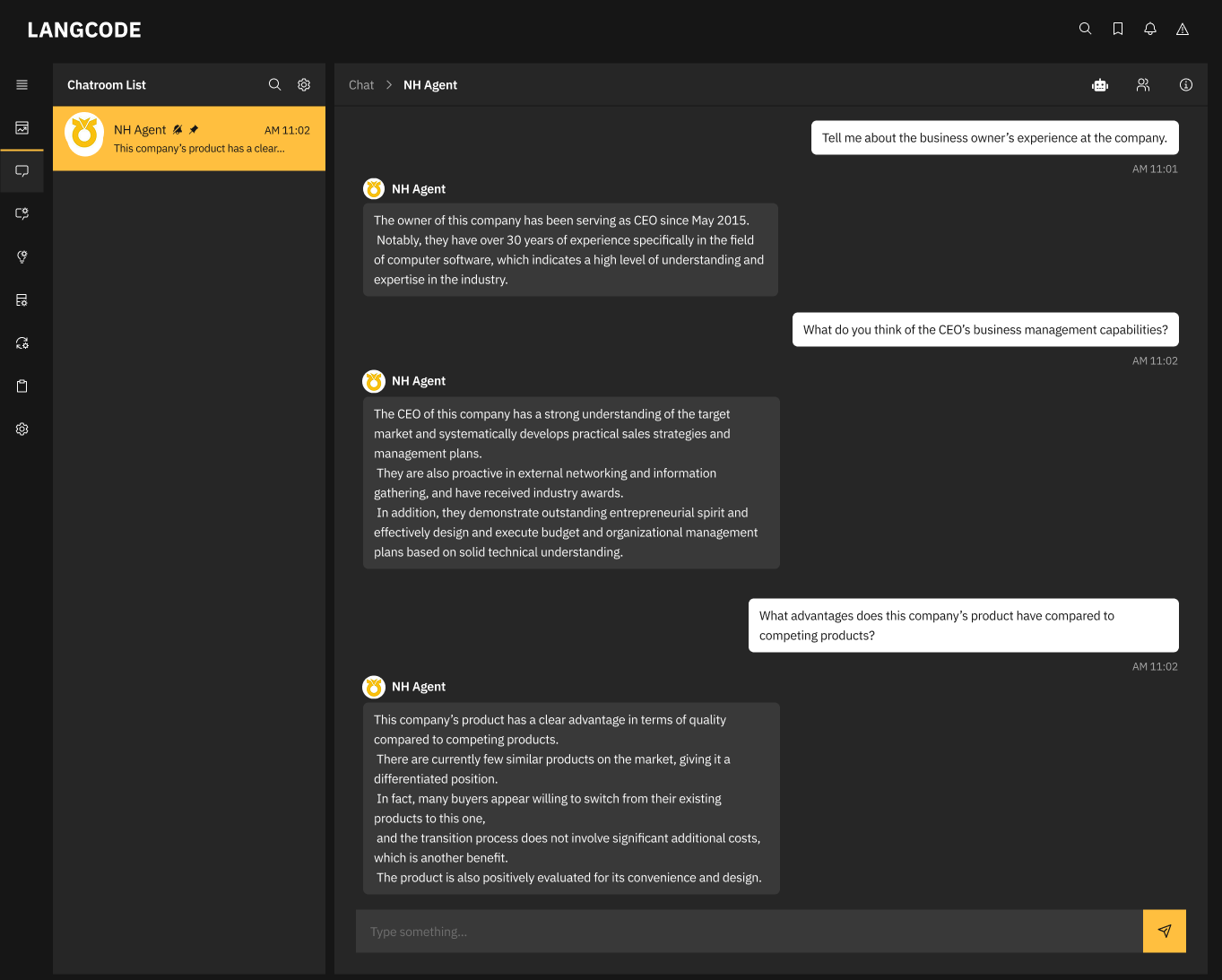
Evaluation data received through EAI (Enterprise Application Integration) is processed according to TCB standards, and data for each evaluation criterion is combined to generate a report draft. The results are delivered to existing work screens so evaluators can use them right away.
A security architecture separating internal network, relay, and cloud tiers
User access, source data, the file server (FOS), and the feedback database remain on the internal network, with only LLM inference and search processing delegated to the cloud.
The relay service handles encryption and decryption of messages, data, and documents, ensuring internal data is never exposed externally in plaintext.
Dual PII detection combines an in-house API for the first pass with Azure AI Language for the second, applied identically to both queries and uploaded documents.
Dictionary-based query blocking and SSO authentication run on the internal network, enforcing control before anything is sent externally.
The relay monitoring server collects usage history and system logs and forwards them to the bank's SIEM.
Automated TCB report drafting through internal EAI integration
Evaluation data received over EAI is passed to the TCB bot, which consolidates the multiple columns scattered across each criterion into generated explanatory and summary text.
Requests are classified as market and technology or other, so market and technology items draw on knowledge store search results as supporting evidence while the remainder are handled through the meta prompt alone.
Market and technology reports are sorted by recency, and their key points are summarized in the format specified by the client.
Generated results are returned over EAI to the internal system, so evaluators can use them immediately as report drafts within their existing work screens.
User-tailored generation logic through a meta prompt architecture
A dedicated set of TCB meta prompt rules lets frontline staff easily modify the generation logic to match their own workflows and evaluation criteria.
Users define which columns to reference and how findings should be phrased for each criterion, allowing flexible handling of diverse cases.
Version control for knowledge stores and prompts, integrated with approval workflows
Prompt edits create a new version rather than overwriting the existing entry, preserving the full change history.
Creation, modification, and deletion of bots, prompts, knowledge stores, and documents are routed through the bank's approval process, so changes take effect only through controlled procedures.
Only documents approved through the approval process are applied, so answers are always generated against the latest baseline.

Impact

From writing reports to reviewing drafts
Drafts covering 40+ evaluation criteria and hundreds of data points per report are generated automatically.
Evaluators' work has shifted from looking up data and writing sentences to reviewing and revising drafts.
Consistent drafting standards and verifiable output
Shared reference data and drafting standards reduce variation between evaluators and the risk of data omissions in manual work.
Generated results can be traced back to designated reference documents.
A foundation for running generative AI in a separated network
Dual PII detection and controlled change history for prompts and documents establish an AI operating framework aligned with internal banking standards.
Usage and system history are linked to security monitoring, supporting operational monitoring and audit response.

How we work

Architecture designed around banking security requirements
A structure frontline staff can adjust and operate themselves
AI operations aligned with existing internal control procedures

Subscribe to Newsletter (TX Insight)

Langcode publishes a newsletter every month on the third Wednesday of the month (TX Insight).
To stay up to date with Langcode news and the latest IT trends and insights, click the Subscribe button below.