

LGJ Center

LGJ Center

최원석 2026.10.01

Project Information

Company NamePremier Partners
Project NameAI Agent for Investment Review
IndustryFinancial (Venture Capital)Data FormatPDF·XLSX·DOCX
Integration-Cloud-
LLMGPT-3.5Solution VersionCXP 1.0 (추측)

AI Agent that analyzes portfolio company financial documents with won-level accuracy and performs calculations

Financial statements and shareholder registers are classified and stored as structured data by item, enabling the Agent to extract only the required year, quarter, and data fields from user questions and perform calculations directly. This provides an environment for deriving key investment indicators from the financial data of approximately 20 portfolio companies.

Challenge

Venture capital investment reviews require a high level of accuracy in financial data. However, large volumes of shareholder registers, financial statements, contracts, and other documents are accumulated in different formats across portfolio companies, making it difficult to verify exact figures and perform complex calculations through conventional document search alone.
Large volumes of unstructured financial documents and high accuracy requirements
Approximately 50–100 documents are accumulated for each of around 20 portfolio companies, including shareholder registers, financial statements, contracts, and employee enrollment lists for the four major social insurance programs
Investment reviews require quarterly revenue, operating profit, major shareholder ownership ratios, and other figures to be verified down to the won and 0.1% level
Tabular outputs are required to compare the financial status of multiple companies at a glance
A method is required to derive, through queries alone, metrics such as Runway and Monthly Burn that are not explicitly stated in the source documents and require additional calculation

Solution

Rather than searching documents for similar content, financial data was structured at the item level so that the values required for each question could be retrieved and calculated directly.
Transition from document search to structured data-based processing
Moved away from the existing search-based chunking approach by classifying key data from financial statements and shareholder registers at the item level and storing it in a structured database, Cosmos DB
Replaced document-level similarity search with item-level data retrieval, enabling accurate verification and calculation of financial figures
Intent-based data extraction and calculation
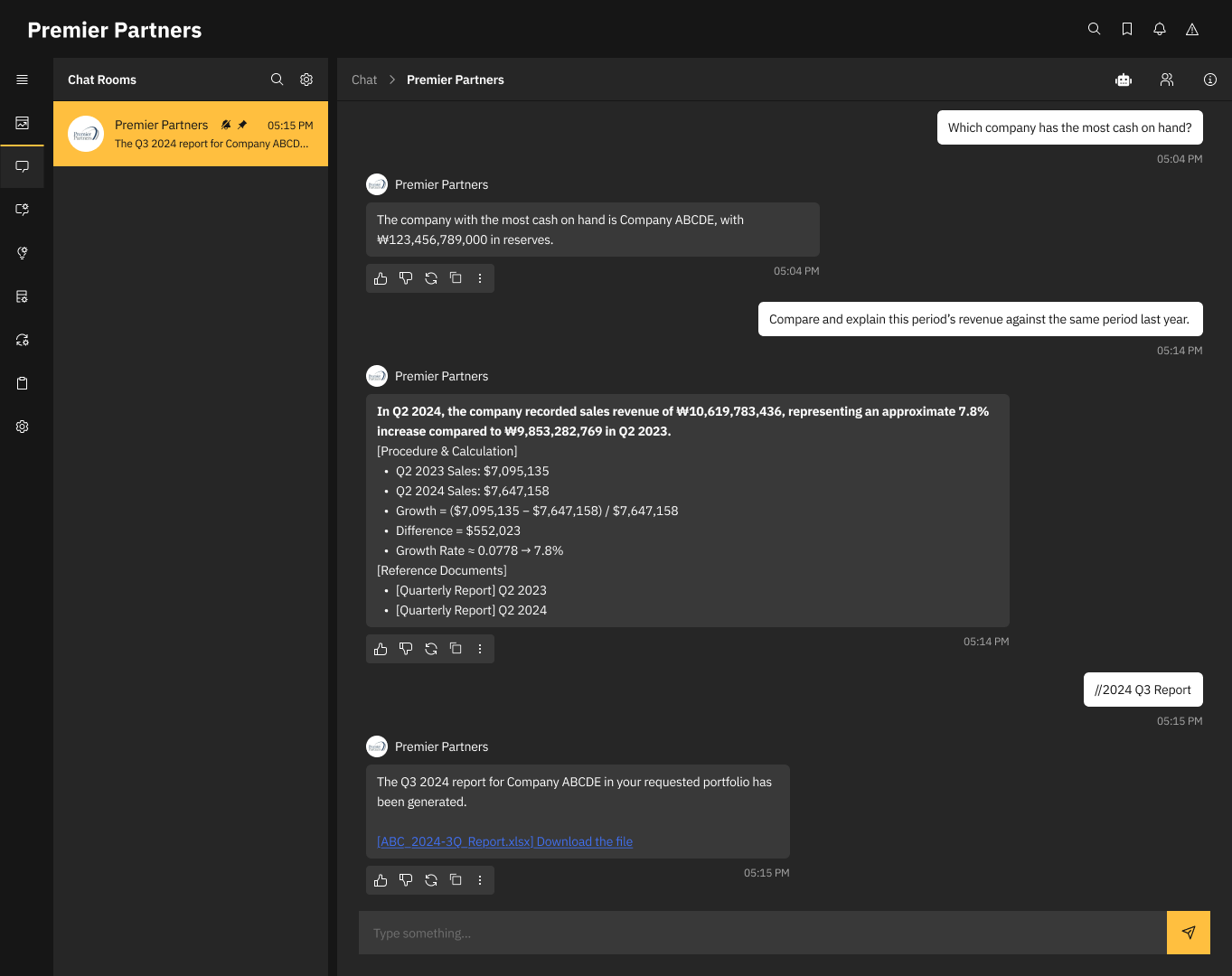
Identifies the company, year, quarter, and data fields required by each question and extracts only the relevant data
Determines the intent of each user question, retrieves required items such as revenue, operating profit, and Monthly Burn, and performs calculations as needed
Generates answers based on the extracted and calculated data while providing the calculation process and reference documents so users can verify the basis of the results
Query and output functions tailored to investment review workflows
Enables users to specify a portfolio company and query only that company’s documents and financial data
Enables financial data from multiple portfolio companies to be exported immediately as XLSX files for comparative analysis and report preparation

Impact

Accuracy secured for calculated financial figures
Quarterly revenue and operating profit are calculated down to the won, and ownership ratios to 0.1%, securing the accuracy required for investment reviews
Derived indicators not explicitly stated in source documents, such as Runway and Monthly Burn, can also be calculated through natural-language questions alone
Verifiable results and connection to follow-up work
Provides the calculation process and reference documents together, enabling users to check and verify the basis of the results
Exports financial data for each portfolio company immediately as XLSX files, connecting the results to follow-up analysis and report preparation

How we work

Defined data models by analyzing document types for each company
Analyzed the structure and recorded items of key documents such as shareholder registers and financial statements for each company, and defined the items to be structured in the DB and their data units
Selected structuring targets and determined the data loading approach
Identified items for which simple text search and chunking could not ensure numerical accuracy, and finalized the targets for conversion to structured data and the loading structure
Categorized investment review queries and established processing criteria
Classified the types of queries arising in investment reviews, and established processing criteria by distinguishing items stated in documents from derived indicators that require calculation

Subscribe to Newsletter (TX Insight)

Langcode publishes a newsletter every month on the third Wednesday of the month (TX Insight).
To stay up to date with Langcode news and the latest IT trends and insights, click the Subscribe button below.