

NH Bank

NH Bank

최원석 2026.10.01

Project Information

Company NameNH Bank
Project NameGenerative AI Based Automation of Suspicious Transaction Report (STR) Writing
IndustryFinanceData FormatAnomaly detection data (structured transaction data, text)
IntegrationAnomaly detection system (API)CloudAzure
LLMGPT-4o, GPT-3.5Solution VersionCXP 1.0

An Agent that automatically drafts Suspicious Transaction Reports (STR) from anomaly detection data

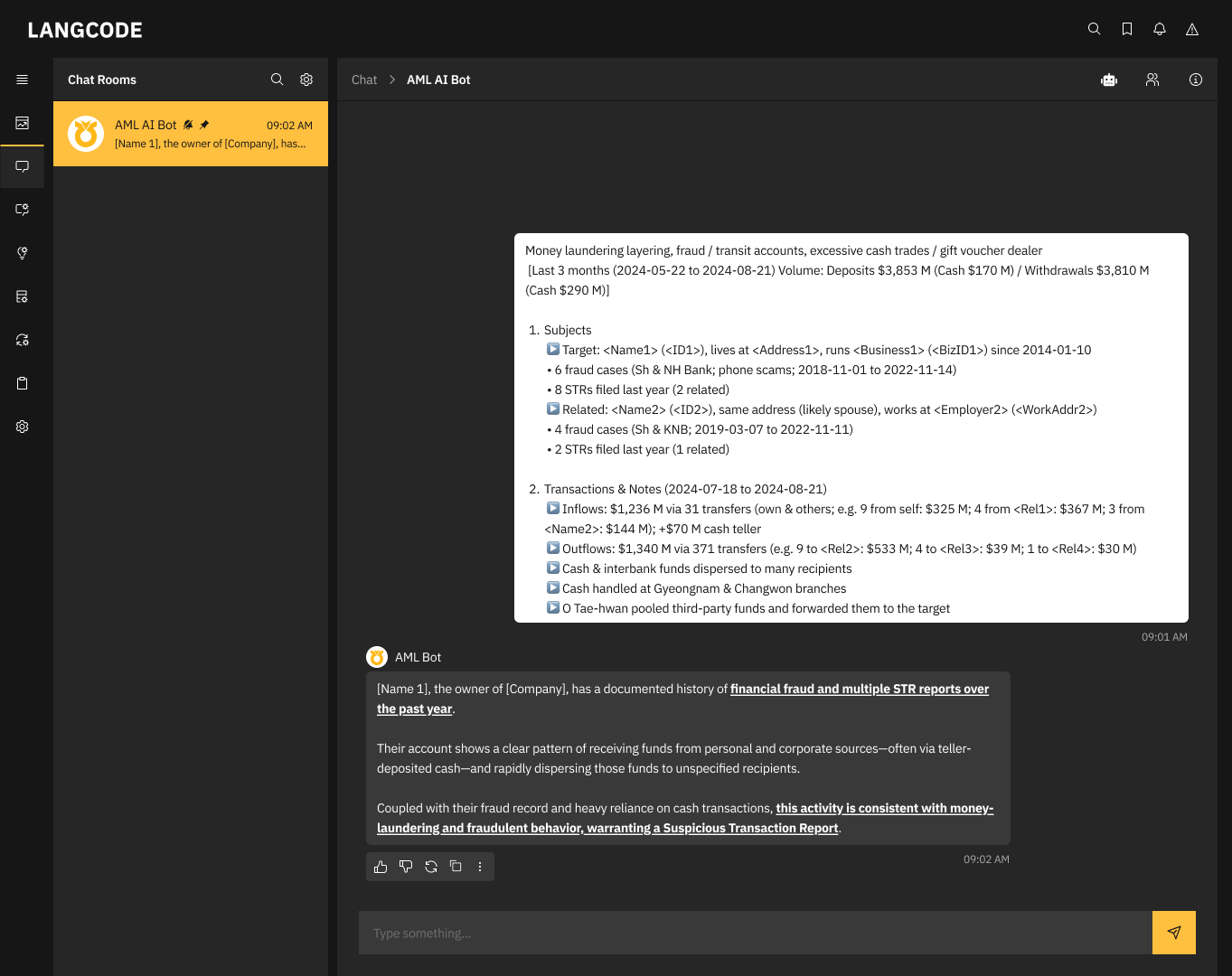
An environment that reasons over the transaction patterns, suspected offenses, and corporate information delivered by the anomaly detection system in two separate steps, case retrieval and rationale derivation, drafts all five sections of the STR report from transaction circumstances and anomalies through suspicion assessment and reporting rationale, and then presents two opposing interpretations together so that the analyst makes the reporting decision.

Challenge

Suspicious Transaction Reporting (STR) is work in which an analyst re-examines each case flagged by the anomaly detection system, organizes the transaction circumstances and anomalies, infers the suspected offense, and then determines whether to report and writes the rationale. Detection data accumulated at a scale of hundreds of cases, yet judgment and narration depended entirely on manual work, creating a heavy workload and leaving no systematic way to manage the risk of flagging normal transactions as suspicious or missing genuinely suspicious ones.
Time and resources consumed from detection through report writing
The entire process, from extracting suspicious transactions to assessing suspicion levels and writing the final report, relied on the analyst's manual work.
Search costs recurred case by case, as analysts had to locate similar past reports and supporting evidence to write each rationale.
Systematic management was lacking for the risk of misclassifying normal transactions or missing abnormal ones.
Manual work across hundreds of detection cases
Repetitive, standardized STR report writing accumulated continuously, sharply increasing workload.
Analysts carried the burden of handling every stage at consistent quality, from identifying transaction circumstances and anomalies to inferring suspected offenses, deciding whether to report, and writing the rationale.
Differences in individual experience and judgment criteria undermined the consistency of report content.
A process that must reflect the characteristics of each financial crime type
The circumstances and evidence to be described differ by suspected predicate offense, including voice phishing, illegal gambling, tax evasion, and money laundering layering.
Transaction patterns such as unusual cash activity, unusual check activity, pass-through account transactions, and corporate transactions each require a tailored reporting rationale.
Type-specific phrasing had accumulated only in individual analysts' experience and was never organized into a baseline the system could reference.

Solution

We restructured the workflow so that AI supports the case searches and report writing that used to repeat after anomaly detection, while the final reporting decision stays with the analyst. To achieve this, we defined multi-step reasoning that separates case retrieval from rationale derivation, along with generation criteria for each report section.
Automated analysis of anomaly detection data
The AI Agent receives transaction patterns, suspected offenses, and corporate information from the anomaly detection system via API and analyzes them automatically.
Related-case retrieval and suspicion-rationale derivation are separated into distinct LLM calls, with the AI reasoning engine managing call sequencing and consolidating the results.
Processing runs in the order of retrieval, augmentation, and generation, so the past cases and evidence secured at each step feed into the prompt for the next.
Drafting against the STR report format
Drafts that fit the STR report format are written by applying the report sentence patterns defined for each rule.
Prompts are separated by section, including customer information, transaction circumstances and anomalies, and suspicion assessment and reporting rationale, generating text suited to each section before consolidating everything into the final assessment and rationale.
The rationale is written by selecting the sentence patterns matching the suspected predicate offense and transaction pattern, shifting the analyst's work toward draft review and final judgment.
Dual analysis from opposing perspectives for decision support
The same transaction data is analyzed from the view that money laundering intent is unclear and from the view that it is evident, with each result returned as a separate answer.
The conservative analysis presents grounds for withholding a suspicion finding, while the assertive analysis presents grounds supporting it.
Rather than issuing a single conclusion, the two interpretations sit side by side so the reporter reviews the opposing grounds before deciding whether to report.
A feedback loop for continuous improvement
Analysts register best-practice examples as keyword, user question, and bot answer sets to instruct the system on preferred response patterns.
User feedback on responses is collected through the UI, and the AI retrieves what it needs from that feedback and applies it to subsequent generation.

Impact

Answer quality validated through practitioner testing
Five practitioners across 62 test sessions scored the system 4 out of 5
The benchmark applied was stage two of the three-stage STR writing process, the AML team monitoring staff's initial reporting assessment and report preparation.
Sections drafted by the AI Agent expanded from 1 to 5
Expanded from automatically drafting a single section, the reporting rationale, to automatically drafting all five sections of the STR report.
Narrowed variance in phrasing between analysts
Type-specific phrasing that had lived only in individual experience shifted into a structure where drafts are produced against rule-based sentence patterns.
The work of locating past reports case by case is now handled by the Agent's case retrieval step.

How we work

Structuring existing STR cases into type-specific writing rules
Classified existing STR report cases along two axes, suspected predicate offense, including voice phishing, illegal gambling, tax evasion, and money laundering layering, and transaction pattern, including cash, checks, and pass-through accounts, and defined the sentence patterns for each type as rules.
Validating frequent types first, then widening coverage
Rather than covering every type at once, started with frequently occurring types such as cash transactions and widened the target types on the evidence of practitioner test results.
Analyzing the writing requirements of each STR report section
Separated the report into sections, including customer information, transaction circumstances and anomalies, and suspicion assessment and reporting rationale, and defined the nature of the writing and the information each section requires.

Subscribe to Newsletter (TX Insight)

Langcode publishes a newsletter every month on the third Wednesday of the month (TX Insight).
To stay up to date with Langcode news and the latest IT trends and insights, click the Subscribe button below.