

NOL-Universe

NOL-Universe

최원석 2026.10.01

Project Information

Company NameNOL-Universe
Project NameAI Agent for Inquiry Normalization and Consultant Support
IndustryE-CommerceData FormatExcel
Integration-CloudAzure
LLM-Solution VersionCXP Agent

A generative AI agent that standardizes CS inquiries and connects them to suitable answers

An environment that normalizes CS inquiries accumulated in Excel across domestic and international flights, performance tickets, and more, classifies them into three levels, and matches existing FAQs and answer templates as a top three similarity list to support consultants in drafting responses.

Challenge

When inquiries were classified manually after various CS consultations across domestic and international flights, performance tickets, and more, identical inquiries were entered into different categories depending on the agent, and a lack of detailed criteria meant many inquiries were handled as 'Other'. Consultants had to find FAQs and one to one answer templates themselves every time, and inefficiency kept recurring while handling more than 80,000 inquiries a month.
Classification criteria that varied by person
With a broad product range and diverse inquiry types across domestic and international flights and performance tickets, unifying classification criteria was difficult.
Categories were entered manually by agents, so identical inquiries were classified into different categories depending on judgment.
Inconsistent classification results made it structurally difficult to aggregate and analyze inquiries by type.
Classification criteria that were not granular
Overlapping criteria and a shortage of detailed categories meant many inquiries were handled as 'Other', leaving the classification scheme underused.
Only high level statistics accumulated, limiting analysis of the specific causes and recurring patterns of inquiries.
FAQs and one to one answer templates searched again every time
Consultants searched the existing FAQs and one to one answer templates directly for every inquiry to write responses.
Scattered reference materials meant finding the right item repeatedly took time.
Repetitive searching and drafting made it hard to focus on actual customer support.

Solution

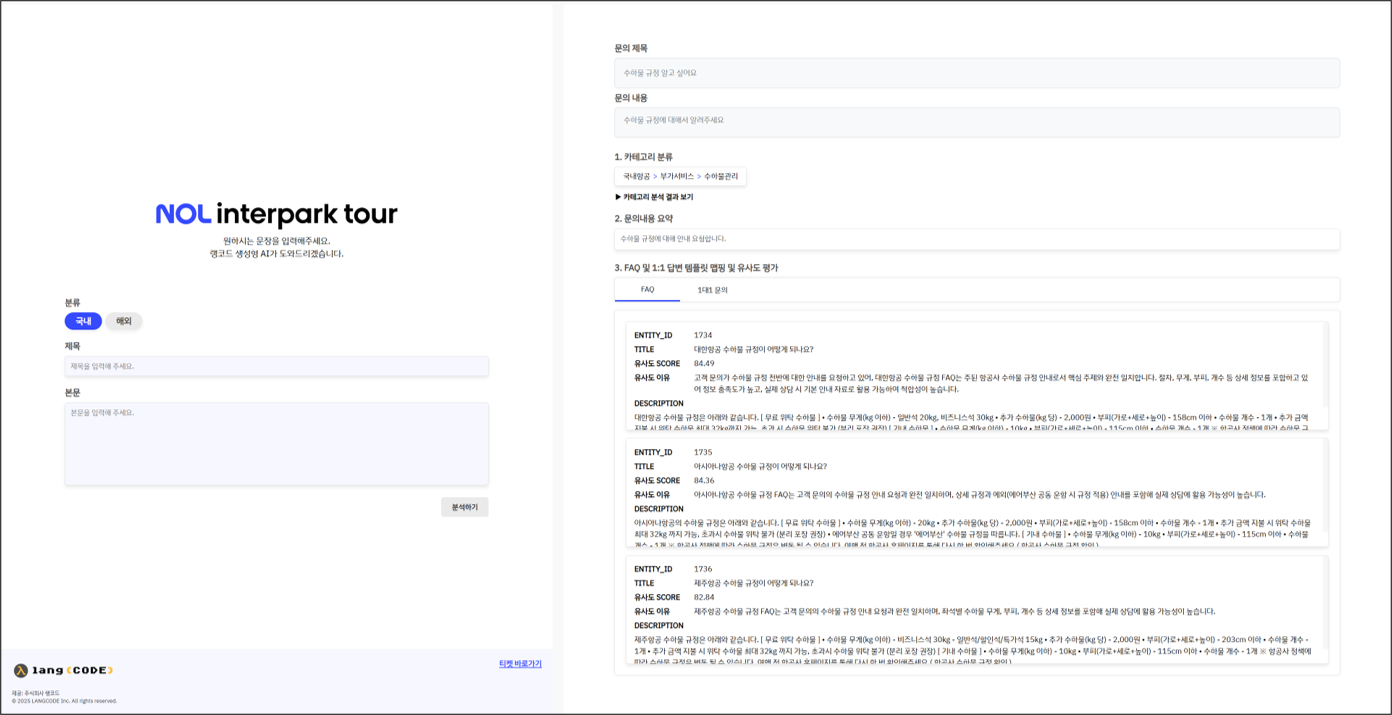
We analyze real inquiry data and the nature of the work to design a three level classification scheme, and when a consultant enters an inquiry, the agent summarizes and normalizes the content for automatic classification and presents the most similar FAQs and answer templates with scores. We designed it so that simply registering an inquiry secures consistent classification and the supporting basis for a response at once.
Three level automatic classification based on inquiry summarization and normalization
Flight and entertainment inquiry data are split by domain, and the real inquiry data and the nature of the work are analyzed to design a three level classification scheme that reflects detailed types.
Even inquiries once handled as 'Other' are subdivided by the AI without agents handling them one by one, and the same criteria are applied consistently to new inquiries.
When a consultant enters an inquiry, RAG references the existing FAQs, templates, and classification standard, and the LLM summarizes and normalizes the inquiry before classifying it automatically.
FAQ and answer template mapping combining search and vector similarity
The top three FAQs most similar to the inquiry are extracted, and vector similarity produces a score.
The most similar one to one answer templates are also retrieved as a top three list with similarity scores.
Compound inquiries are split by the AI into several single questions and mapped individually, while unmatched inquiries below 30% similarity are grouped to automatically generate new FAQ candidates.
Result validation by similarity threshold and operational use
Matches are presented with similarity scores, with a 70% baseline in the UI to judge reliability, and items with no suitable match are marked as none.
Uploading an Excel file classifies inquiries in bulk, visualizes the taxonomy as graphs and tables, and lets users download the results as Excel.
Classification and mapping results are provided as analysis reports, extending to response generation and comparative analysis on sampled inquiries.

Impact

Applied to more than 80,000 CS inquiries a month: Automatic classification and answer template matching applied to monthly inquiries of about 64,000 flight and about 22,000 entertainment cases.
Unified and better utilized inquiry classification criteria: Redesigned an underused classification scheme into three levels fitted to the nature of the work, securing a foundation for detailed analysis of inquiry types.
Built a knowledge asset system based on analysis of unmatched inquiries: Established a cyclical structure in which recurring inquiry patterns can be accumulated as knowledge assets.

How we work

Defining the integration scope with the existing CS system
Set the scope to integrate only the AI capabilities without replacing the existing support system, and designed an integration approach that uses existing materials such as FAQs and answer templates as is.
Redefining classification criteria based on analysis of real inquiry data
Analyzed more than 80,000 monthly inquiries and responses to identify why inquiries concentrated in 'Other' under the existing scheme, and redefined the classification levels and detailed criteria to reflect the nature of the work.

Subscribe to Newsletter (TX Insight)

Langcode publishes a newsletter every month on the third Wednesday of the month (TX Insight).
To stay up to date with Langcode news and the latest IT trends and insights, click the Subscribe button below.