

Changshin INC

Changshin INC

최원석 2026.10.01

Project Information

Company NameChangshin INC
Project NameQuick Response Center Pilot Project (Quality Issue Analysis Automation)
IndustryManufacturingData FormatExcel, PPT, PDF
IntegrationData Visualization LibraryCloudAzure
LLMGPT-4Solution VersionCXP Agent

A Manufacturing Q&A Agent That Automates Quality Issue Analysis

A Quick Response Center agent that searches unstructured quality documents in one place, then retrieves, aggregates, and visualizes the needed information to respond in the format best suited to each question's intent

Challenge

Quality issues on the production floor were dispersed across documents and emails in different formats, so the necessary information had to be located and aggregated manually. The same work was repeated over and over, and omissions occurred in aggregation as people checked the dispersed materials by hand.
Quality information with scattered document formats and storage locations
Quality issue information was scattered across multiple channels such as field records and emails, making it hard to grasp the overall status at once.
Each document had a different structure and format, making it inefficient to retrieve, compare, and analyze information on the same basis.
Limits of manually searching large volumes of unstructured documents
There was no system for integrated search across large volumes of unstructured documents or for rapidly securing information that meets specific conditions and scenarios.
Every time issue status, counts, or trends had to be checked, related documents were searched directly and the data reorganized again, and information was omitted along the way.

Solution

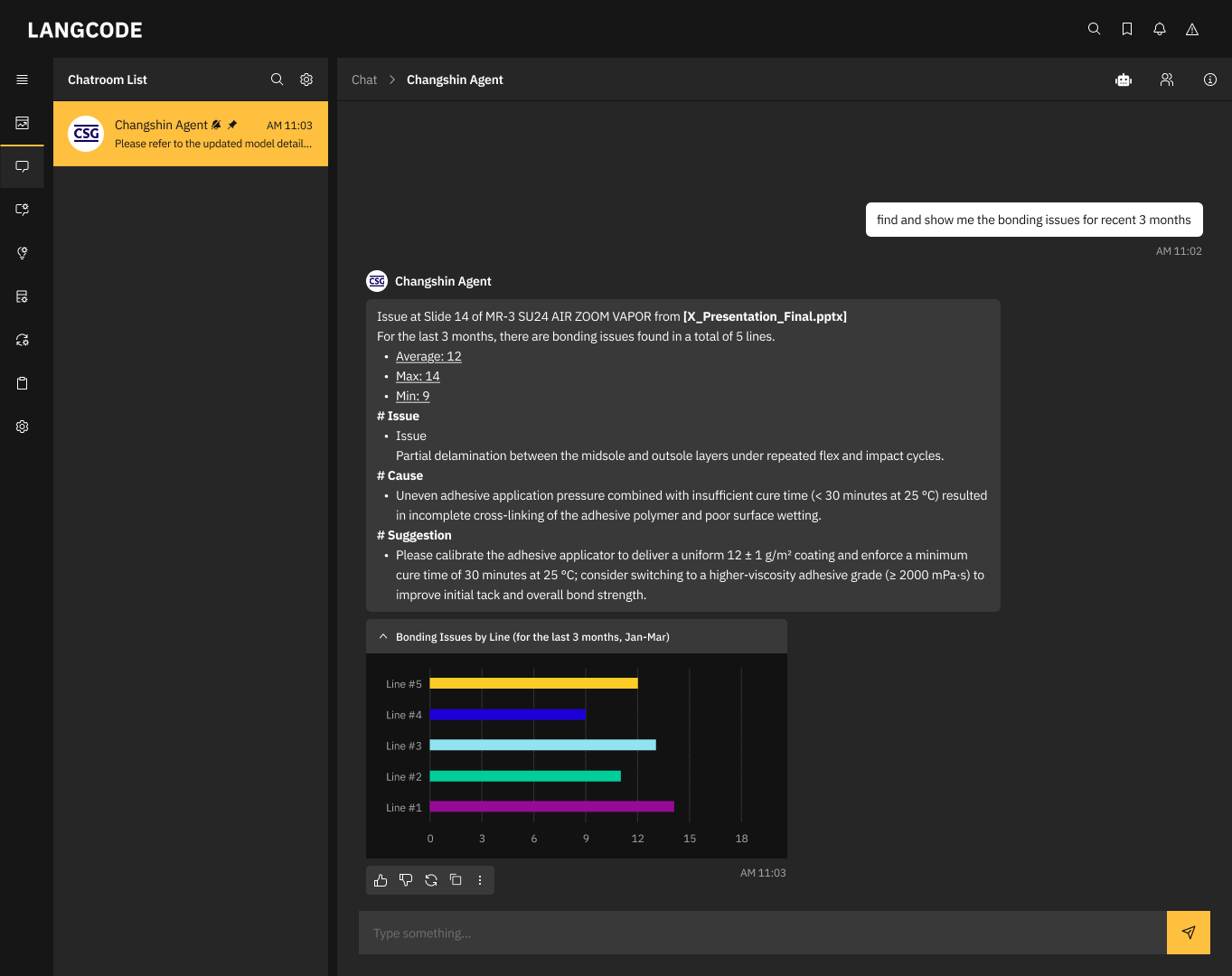
We shifted manual document search to natural language question based lookup and aggregation, and built a quality issue analysis AI agent that delivers results in the most suitable format, such as text, lists, or charts, according to each question type.
Search and response paths by question type
Question types are classified based on the key expressions and conditions in each question, then routed to the appropriate search and response path.
Quality information needed for each question is searched using specific items, keywords, and conditions.
Integrating unstructured quality documents and responding by question type
Quality documents in various formats such as FMEA, MR, and PDF are preprocessed into a searchable knowledge base.
Responses are generated as text, lists, or charts according to the question type, with numeric data such as issue counts visualized.
Linking supporting documents with past response cases
Retrieved supporting documents are standardized and provided in summary form, so practitioners can verify the source of each answer.
Numeric data is provided together with past issue response reports and lessons learned, so existing response cases can be referenced when similar issues occur.

Impact

The time spent on quality issue analysis, including data collection, processing, and visualization, dropped from 4 hours to about 1 minute.
Less repetitive document searching and data organization eased the manual workload of quality management.
An integrated lookup environment for dispersed quality information reduced aggregation omissions.

How We Work

Analyzing structure and setting preprocessing criteria by document type: We analyzed the structures of different quality documents such as FMEA and MR, defined preprocessing criteria to convert them into a searchable form, and then finalized the scope of the knowledge base.
Defining response formats by field question type: Questions that recur in the field were classified into lookup, aggregation, and trends, and the conditions and response formats, such as text, lists, or charts, were defined for each type.

Subscribe to Newsletter (TX Insight)

Langcode publishes a newsletter every month on the third Wednesday of the month (TX Insight).
To stay up to date with Langcode news and the latest IT trends and insights, click the Subscribe button below.