

LF Networks

LF Networks

최원석 2026.10.01

Project Information

Company NameLF Networks
Project NameRetail Data Analytics AI Agent
IndustryRetailData FormatExcel
IntegrationEISCloud
LLMGPT-4.1Solution VersionCXP 1.0

AI Data Analysis Agent That Replaces Manual Excel and Pivot-Table Analysis with a Single Natural-Language Question

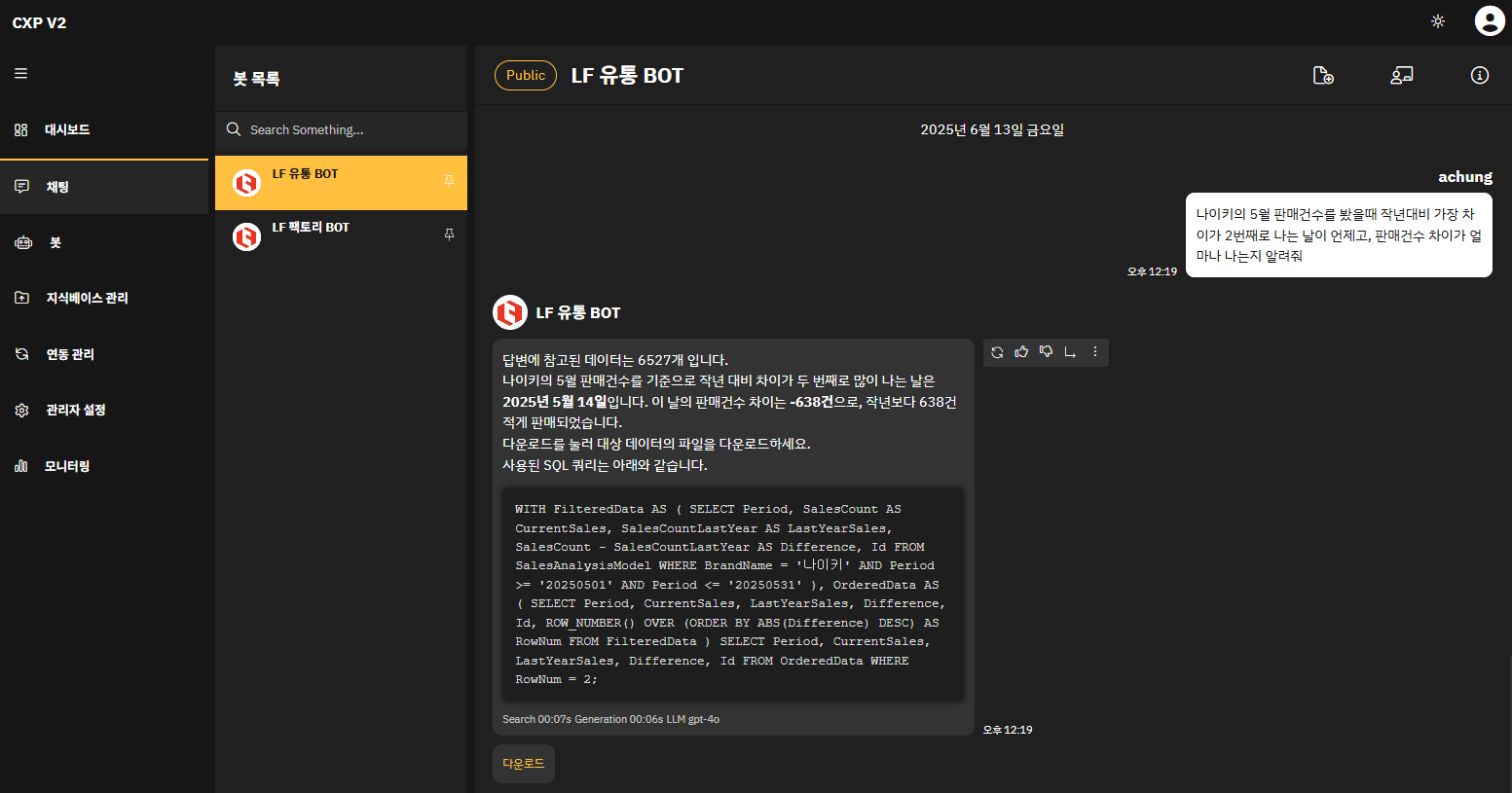
An environment where business users can directly perform analyses that previously required significant time in the existing EIS, combining multiple metrics such as sales, transaction value, and commission rates by brand and location through natural-language questions, while also providing the actual SQL queries executed and referenced data.

Challenge

Data analysis in apparel retail operations relied heavily on manual Excel and pivot-table workflows. In particular, analyses that required combining multiple metrics—such as sales, transaction value, commission rates, and sales per unit area by brand and location—took considerable time even within the existing EIS, resulting in repeated data extraction and processing workloads.
Recurring limitations of manual Excel and pivot-table analysis
Metrics such as sales transactions, margins, transaction value, and sales were separated by brand and location, requiring multiple datasets to be individually extracted and combined to answer a single question
Most business queries, including growth, efficiency, and exception detection, required analysis across multiple metrics and were therefore highly complex even within the existing EIS
Similar data extraction and processing steps had to be repeated for each analysis, regardless of whether the objective was year-over-year comparison, trend analysis, or anomaly detection

Solution

We implemented an AI Agent that converts natural-language questions into SQL queries to directly retrieve and analyze internal data for analyses that previously required significant processing time in the existing EIS.
Natural-language-based automation of multi-metric analysis
Analyze multiple metrics in real time using natural-language questions alone, with results visualized through charts and graphs
Support combined analysis and trend analysis across multiple metrics, including growth patterns, efficiency, and anomalies by brand and location
Verification of analysis results and connection to downstream workflows
Provide the actual SQL queries executed and the number of referenced data records together with each answer, enabling users to verify the basis of the analysis
Allow users to export the data used in the analysis for use in existing reporting and downstream analytical workflows
Access control and response quality management by business unit
Separate bots by business unit, such as retail and factory operations, and manage data access scopes through member roles and permissions
Improve response accuracy for internal terminology and recurring queries through a user dictionary for synonym mapping and Q&A management
Operational monitoring and cost management
Monitor key operational metrics, including total Q&A volume, active users, AI response rate, and feedback insights, through a dashboard
Manage operating costs through LLM selection and token threshold settings based on model performance, characteristics, purpose, and cost

Impact

Shift from manual Excel analysis to natural-language-based analysis
Transitioned analyses that were highly complex in the existing EIS to real-time analysis based on natural-language questions
Reduced repetitive data extraction and processing workloads, enabling business users to perform analyses directly through questions
Establishment of analysis result verification and operational management
Provide SQL queries and referenced data together with analysis results, enabling users to verify and validate the basis of the results
Established a framework for continuously monitoring usage and response quality based on operational metrics

How we work

Analysis of EIS-integrated data and internal database structures
Analyzed EIS-integrated data and internal database schemas, and defined usage scopes and data access permissions by business unit
Definition and validation of test query sets by business query type
Defined and validated test query sets for business use cases such as growth analysis, efficiency assessment, exception detection, and trend analysis, while collecting and defining internal terminology and identifying recurring query types
Design of the natural-language query processing pipeline
Designed a step-by-step processing structure that generates and executes SQL from natural-language queries, then presents the query results together with supporting evidence, while defining how data is passed between each stage

Subscribe to Newsletter (TX Insight)

Langcode publishes a newsletter every month on the third Wednesday of the month (TX Insight).
To stay up to date with Langcode news and the latest IT trends and insights, click the Subscribe button below.