

Hanwha Ocean

Hanwha Ocean

최원석 2026.07.02

Project Information

Company NameHanwha Ocean
Project NameEvidence-Based Q&A AI Agent for Semantic Search Across Unstructured Conversation Records
IndustryShipbuilding & OffshoreData FormatWord, Excel, PDF
Integration-CloudAzure
LLMGPT-3.5Solution VersionCXP Agent

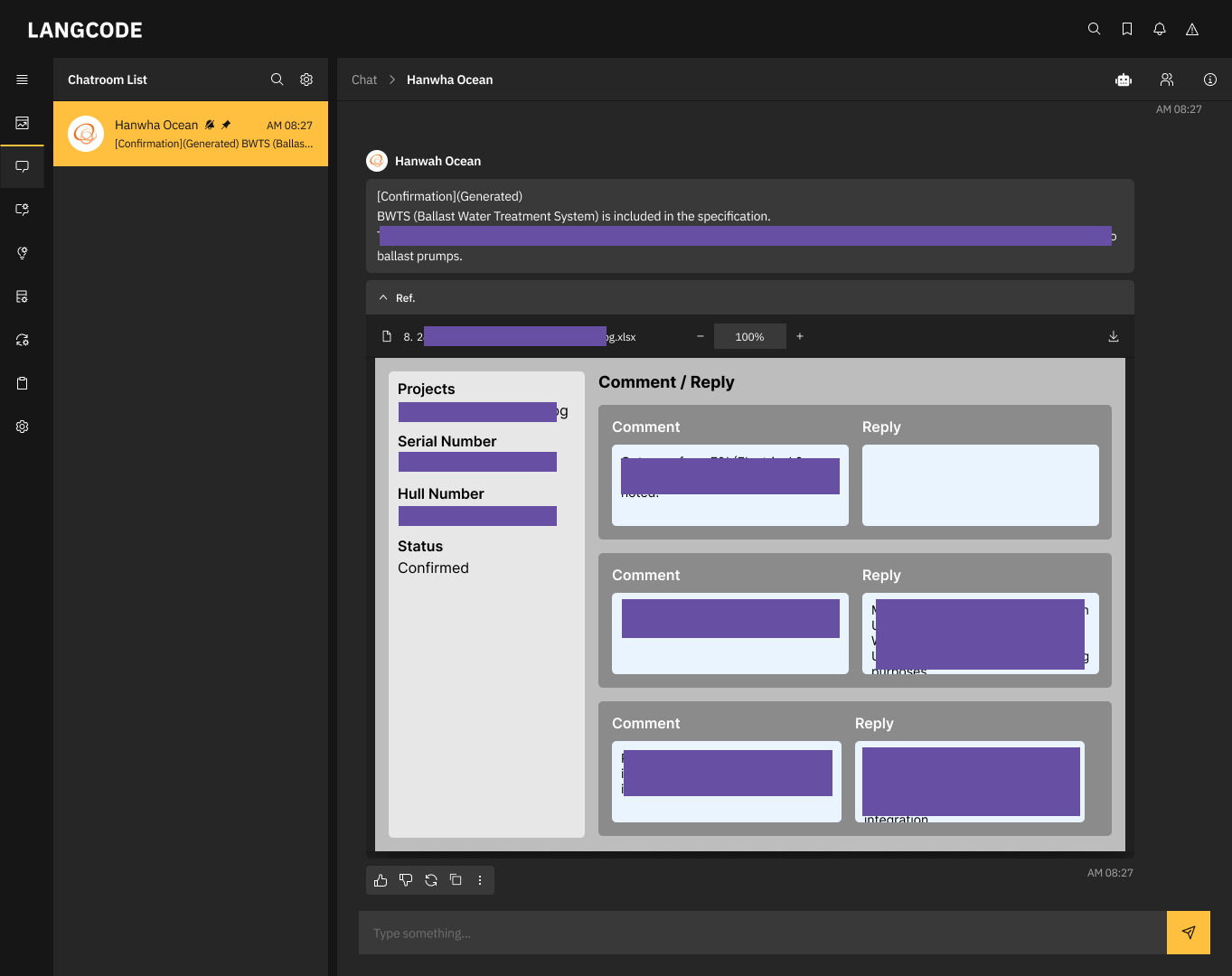
Q&A Agent that enables AI-powered search and answers across the Q&A history between shipowners and the shipyard

A Q&A AI Agent that clusters conversation records scattered across Excel and Word files into semantic units, and delivers answers with evidence and sources attached in table format

Challenge

In the shipbuilding industry, the design and construction of a single vessel generates years of extensive Q&A exchanges between shipowners and the shipyard, and these records should serve as critical reference assets for subsequent projects. Yet frontline teams faced practical barriers that prevented them from leveraging this asset.
Unstructured data rendered unsearchable
Communication records between shipowners and the shipyard were scattered across unstructured documents such as Excel and Word files, making them unsearchable without preprocessing
With no Wiki or guide documents consolidating past history, the same questions recurred yet knowledge was never converted into an organizational asset
Answer processes dependent on manual exploration
Design engineers had to open and review source documents one by one to locate similar past Q&As, taking an average of 2–3 hours per inquiry
Context was fragmented across multiple conversation groups rather than a single document, requiring manual cross-checking of speakers, dates, and sources to produce a reliable answer

Solution

We built a system for leveraging shipowner–shipyard Q&A history through a three-stage pipeline: from automated structuring of unstructured documents, to semantic search, to evidence-based answer output.
Automated structuring pipeline for unstructured documents
AI automatically recognizes and analyzes Excel and Word documents with inconsistent row-column structures, converting the entire body of Q&A data into a structured knowledge base
Automated preprocessing reduced construction time compared to conventional manual data refinement
Semantic conversation clustering
Interprets the meaning of user queries and recognizes conversational flow and continuity, clustering related topics into logical units
Intent-based search — beyond simple keyword matching — achieved a retrieval accuracy of 90%
Structured Q&A history output
Every answer attaches the full set of related conversation groups in table format, complete with speaker, date, and source metadata
Output formatted to the report templates required by the company, eliminating the need for post-processing

Impact

Search time for past Q&As reduced from 2 hours to 10 minutes per case: eased design engineers' burden of handling repetitive inquiries
Years of Q&A records turned into an organizational knowledge asset: prevents know-how loss even through staff departures or turnover
Metadata-based source tracing secures answer credibility: enables immediate presentation of evidence even in potentially contentious matters

How we work

Designing the preprocessing pipeline based on the client's real data: We directly analyzed the client's real data (original Excel and Word files) from the earliest stage to design a preprocessing pipeline suited to actual document structures
Deriving the output format from frontline staff interviews: Through iterative interviews with frontline design engineers, we validated "what answer format actually works in practice" and derived the table-based evidence delivery approach

Subscribe to Newsletter (TX Insight)

Langcode publishes a newsletter every month on the third Wednesday of the month (TX Insight).
To stay up to date with Langcode news and the latest IT trends and insights, click the Subscribe button below.