KOTRA(Korea Trade-Investment Promotion Agency)
| Company Name | KOTRA(Korea Trade-Investment Promotion Agency) |
| Project Name | Building an Integrated AI Agent for Overseas Expansion Information Search |
| Industry | Public | Data Format | HTML, PDF |
| Integration | TradeInvest24 (KOTRA official portal) | Cloud | Azure |
| LLM | - | Solution Version | CXP Agent |
Building an Integrated AI Agent for Overseas Expansion Information Search
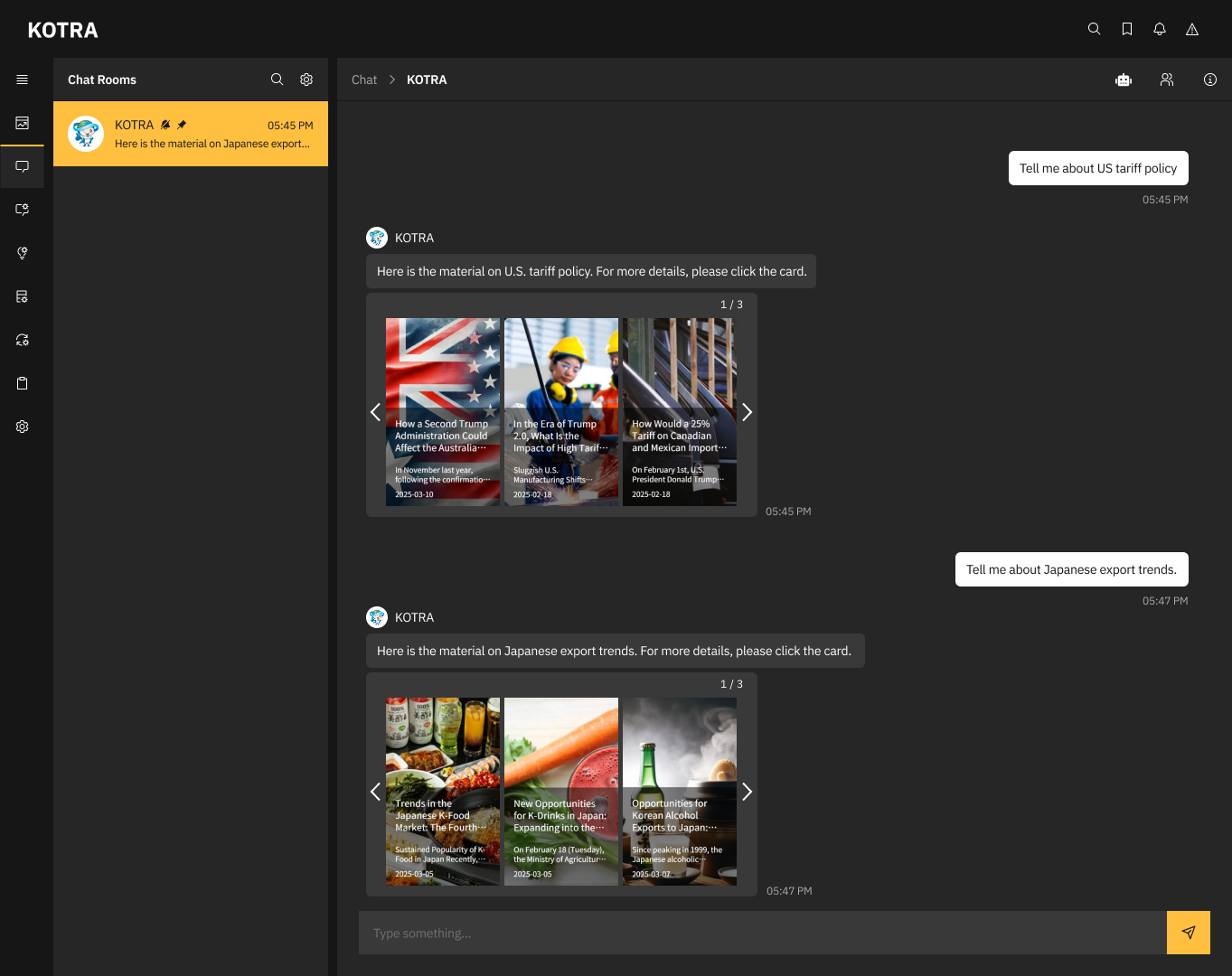
An AI Agent service that implements an integrated search environment allowing users to explore vast amounts of overseas expansion information in natural language and receive immediate, automated responses to questions about support programs — improving both user accessibility and operational efficiency at the same time.
KOTRA held a vast amount of information necessary for overseas expansion, including trade and investment consulting, exhibition participation, overseas market trends, and country-specific industry information. However, this content was scattered across numerous menus and sections, requiring users had to navigate multiple menus and sections to find the information they needed. It was also difficult to judge the recency and relevance of search results, making it hard to quickly find tailored information.
Difficulty navigating due to fragmented information structure
Content types such as trade/investment programs, overseas market news, and country-specific industry information were diverse and located in different sections, requiring multiple navigation steps to reach the desired information The existing search system struggled to effectively support diverse query types ranging from simple keywords to long natural-language questions. Difficulty identifying the latest information within search results
Although data spanning 2022–2025 was available, older and newer information were mixed together in search results, making it difficult to identify the most current information in a timely manner Limitations of the existing AI Agent in reflecting real-time changes, leading to response bottlenecks
The previously built AI Agent had a structure that could not synchronize the characteristics of support programs and their frequently changing details in real time Delays in updating new support programs or overseas market news caused recurring operational bottlenecks, requiring the responsible department to directly respond to user questions We built an AI Agent environment that allows users to explore overseas expansion information in natural language and receive immediate, automated responses to questions about support programs.
Building a multi-source data collection and refinement pipeline
Collected and refined content across KOTRA — including trade/investment programs, overseas market news, and country-specific industry information — via PDF, XLSX, and web crawling methods Simplified long-form text into a format suitable for search, and applied OCR parsing to attached documents within pages so that body content could be included in the search index Advancing LLM-based hybrid search
Used an LLM to define new categories aimed at improving hybrid search performance, and implemented a preprocessing pipeline that effectively handles a variety of query types Applied Gaussian decay so that the most recent content naturally surfaces higher in search results Automating support-program responses based on real-time updates
Real-time updates, revisions, and newly added materials are reflected in the AI Agent immediately, enabling responses that are always based on the most current information Provided both FAQ-based answers and notice/announcement-based answers in parallel, and improved user accessibility by exposing frequently asked questions as clickable buttons Expanded scope of natural-language query processing: a single search bar can now handle everything from simple keywords to complex sentence-based queries Reduced information update reflection time: shifted from a manual response structure to automatic reflection within 5 seconds Automated responses reduced the repetitive inquiry-handling workload of the responsible department, allowing staff to focus on higher-value tasks. Defining requirements from real user query patterns: Analyzed actual usage patterns — keyword searches vs. natural-language sentence queries, information exploration vs. requests for immediate answers — to determine the search structure and response method Designing a real-time reflection structure for a frequently changing domain: From the design stage onward, considered how the system could keep pace with domain changes even after initial deployment, designing a structure in which announcement updates are reflected immediately