KT Unified Multi-Agent Hub
| Company Name | KT |
| Project Name | Coplilot Custom Agent Teams App Integration |
| Industry | Telecom | Data Format | |
| Integration | Copilot Custom Agent, CXP, Teams App | Cloud | Azure |
| LLM | GPT-4.1 | Solution Version | CXP Agent, CXP Hub |
Unified Multi-Agent Hub for Internal Operations
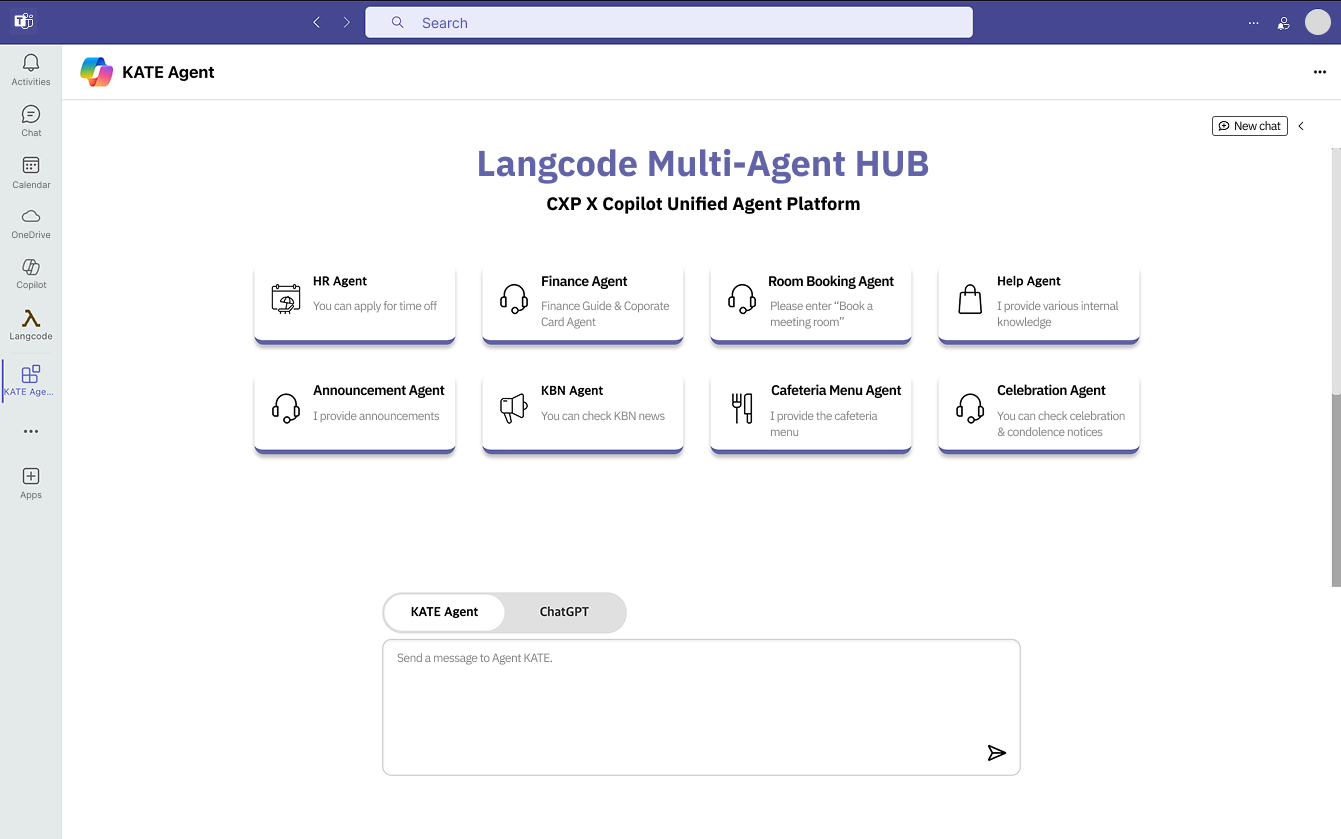
A fully integrated work environment where multiple internal systems and AI Agents operate as one — enabling the right Agent to execute automatically based on task context, without any manual selection.
Despite having AI Agents already in place, fragmented deployment across systems limited their practical usability, making it difficult for Agents to take root as effective everyday work tools.
Lack of Unified Management Due to Fragmented System Operations
AI Agents were built across multiple platforms, but without standardization or centralized management, each operated in isolation — locking the organization into a fragmented structure with no path to scale User Burden of Manually Selecting and Invoking Agents
Users were required to identify and select the appropriate AI Agent for each task on their own This dependency on prior knowledge of each Agent's role created friction, lowering adoption and practical utilization Absence of an Automated Execution Environment for Complex Tasks
Handling multi-step tasks required users to manually switch between multiple AI Agents No unified, natural-language interface existed to streamline this process CXP consolidated fragmented AI Agents and internal systems into a single Multi-Agent Hub — where the right Agent is automatically triggered based on user intent, with no manual selection required.
Dynamically integrates diverse Agent types — MS Copilot, Legacy APIs, and CXP AI Agents — to flexibly address enterprise-wide needs and employee demands Accessible through MS Teams App, enabling seamless use of multiple AI Agents with minimal effort Orchestration-Based Automatic Agent Execution
Normalizes user queries and routes them through an AI Agent Registry for structured workflow selection Supports sequential and parallel execution via a slot-based task management system Automatically identifies and triggers the most relevant Agent based on task context — no explicit selection needed Natural Language-Driven Unified Work Environment
Enables users to complete complex, multi-step tasks through a single interface using natural language alone Eliminates the friction of switching between Agents, ensuring seamless continuity across workflows Unified fragmented internal systems, significantly improving operational accessibility and efficiency Removed the Agent selection process entirely, lowering barriers to adoption and driving greater utilization Established a natural language-based work environment, transforming AI Agents into practical, everyday tools Workflow-First Design: Restructured the Agent architecture around actual work processes — not legacy system boundaries Orchestration-Centric Architecture: Built for scale with a multi-Agent collaboration model, moving beyond single-Agent limitations