



Introduction
With the remarkable advancement of AI technology recently, AI Agents are gaining attention as a core driving force for corporate innovation beyond simple automation tools. In our previous insight on 'AI Agents: Autonomous and Intelligent Future Changes,' we briefly examined how AI Agents perform autonomous decision-making through processes of detection, analysis, planning, and execution, creating real application cases across various industries. In this insight, based on those fundamental concepts, we will focus specifically on the factors considered when implementing them in corporate environments and the changes they bring.
Companies are increasingly adopting AI Agents to maximize operational efficiency and enhance competitiveness, and in this process, various considerations such as data security, system integration, and ethical issues are emerging. These environmental changes serve as both opportunities and challenges that can bring innovation to the overall organizational operations beyond simple technology adoption. This article aims to understand the trends related to AI Agent adoption in enterprises and the challenges that may be faced during actual implementation, as well as strategies to overcome them and their effects. Based on the basic explanation of AI Agents presented in the previous article, let's explore how each company can adopt AI Agents to achieve business innovation in the future.
Enterprise AI Agent Adoption Trends
Recent global surveys confirm that companies' willingness to adopt AI Agents is very high. According to Cloudera's survey, 96% of approximately 1,500 companies that participated in the survey plan to expand their use of AI Agents within the next 12 months, with 57% of companies having already completed adoption in the past 2 years. Similarly, according to a recent Gartner study, more than 85% of companies plan to apply AI Agents to their business operations by 2025.
There have also been studies on current utilization status. In IBM and Morning Consult's developer survey, 99% of 1,000 developers said they are researching and developing AI Agent-related technologies, confirming that capability enhancement is actively progressing across the ecosystem. Also, in Cloudera's survey, 66% of surveyed companies said they are building agents on their own AI platforms, while 60% are employing a mixed strategy utilizing agent functions embedded in existing core applications.
What about future prospects and predictions? According to [Deloitte's survey results, 25% of companies in 2025 and 50% in 2027 are expected to fully adopt AI Agents, suggesting that accelerated adoption will become a reality in the short term. According to a Gartner article, by 2028, 33% of enterprise software applications will include Agentic AI, presenting the outlook that AI Agents will deeply penetrate the overall work environment.
As such, AI Agents have already entered the stage of practical adoption and their expanded application is accelerating across various industries. If investment and development continue, AI Agents will establish themselves as a core axis of corporate competitiveness.
Factors Hindering Enterprise AI Agent Adoption
On the other hand, contrary to expectations, many companies are encountering unexpected obstacles at the implementation stage. Despite projections that the adoption of AI Agents would yield more efficient and faster results, unforeseen problems in the actual field are sometimes delaying entire projects.
The main factors hindering companies' adoption of AI Agents can be categorized into technical integration complexity, data readiness, security and governance concerns, organizational and strategic alignment issues, talent and capability shortages, performance stability, and change management and scalability.
First, in terms of technical integration, 42% of companies report that successful deployment of AI Agents requires connecting at least 8 or more data sources, and 86% demand upgrades to existing technology stacks, causing integration complexity.
Additionally, 48% of companies assess that their existing iPaaS (Integration Platform as a Service) solutions are "somewhat unprepared" to meet the data demands of AI, acting as an obstacle to environment creation.
Data readiness is also considered a major challenge. Many organizations feel that "data is not organized, unprepared, or incomplete," making data cleansing and ensuring governance a priority before utilizing AI Agents.
In the area of security and governance, 53% of technology leaders and 62% of practitioners identify security concerns as their top priority, while 54% of CEOs cite regulatory response and lack of management of unauthorized AI tool usage as organizational risks. For instance, one paper suggests that when an AI Agent accesses a database, malicious actors could exploit the agent to steal sensitive information or exploit system vulnerabilities. Relatedly, according to a 2024 ServiceNow report, 54% of respondents selected cybersecurity as their most concerning challenge.
Finally, the talent and capability aspect can be condensed into performance quality uncertainty and lack of knowledge and time investment.
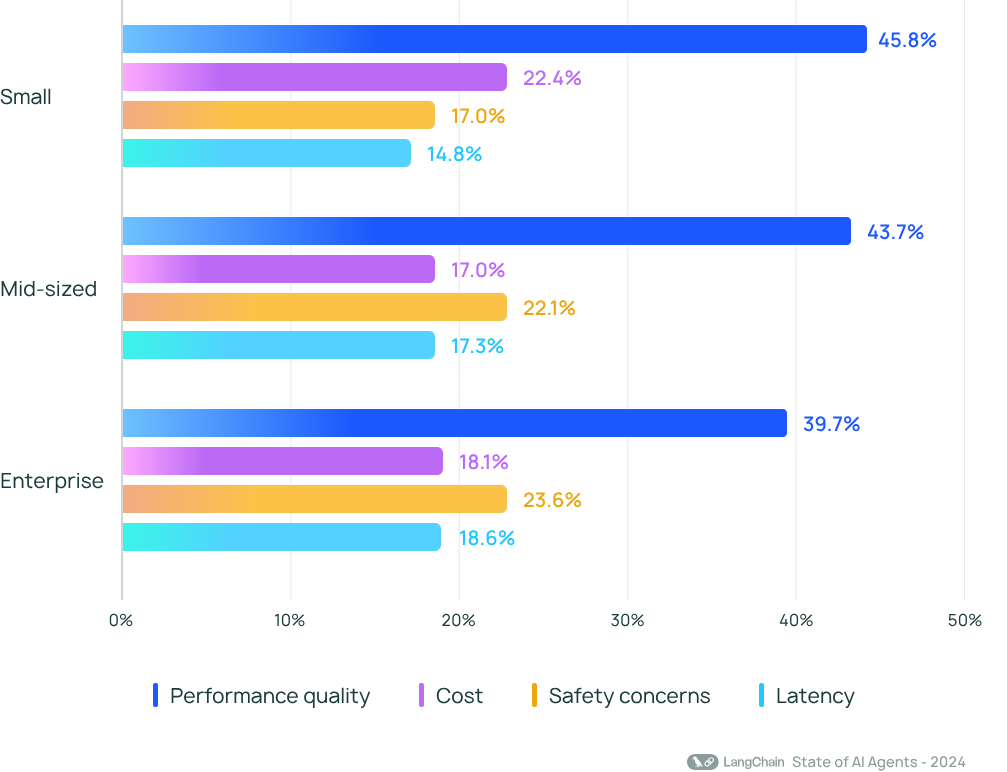
LangChain State of AI Agents - 2024
According to LangChain's data, maintaining the performance quality of LLM-based AI Agents is the biggest obstacle, with opinions that ensuring response accuracy and style consistency is not easy. In fact, 45.8% of small business respondents cited 'performance quality' as the biggest constraint when deploying to production, more than twice as high as cost (22.4%). The unpredictability of LLM workflow control increases the possibility of errors, making stable operation difficult. It is also not easy to secure the expertise and time required for agent design, testing, debugging, and fine-tuning. Many teams struggle to find the optimal best practices for building and validating agents, and employees still need upskilling. This learning curve and high resource investment are key factors delaying the process from the PoC stage to production for enterprise-wide expansion.
AI Agent Adoption Success Strategies and Expected Effects
For companies to successfully adopt AI Agents, a clear strategic approach is essential. Gartner suggests the following key steps for successful pilot implementation of generative AI projects.
First, companies must systematically discover and prioritize practical use cases based on business objectives and the potential value of AI technology. Subsequently, they should focus on the prioritized cases, form fusion teams, and rapidly develop a minimum viable product (MVP). Then, through the establishment of a performance measurement framework, they should define clear KPIs in advance, verify the performance, and decide whether to expand.
Additionally, according to Accenture research, companies are still experiencing the following discomforts in adapting to changes due to AI adoption:
Therefore, when new technology adoption is decided within an organization, it is essential to share its purpose and vision company-wide. This enables systematic change management by resolving employee anxieties and questions under the support of the executive leadership.
The effects that companies can expect when adopting AI Agents are multifaceted. Although direct ROI research on AI Agents is still in its early stages, its potential can be gauged through the adoption outcomes of generative AI, its core technology. According to Accenture research, about three-quarters of companies (74%) found that investments in generative AI and automation met or exceeded expectations, and encouraged by this, 63% of companies plan to expand these efforts and further strengthen capabilities by 2026. In particular, 'reinvention-ready' companies that have adopted generative AI enterprise-wide achieved 2.4 times higher productivity compared to competitors.
These outcomes clearly demonstrate the effectiveness of work automation and decision-making support provided by AI Agents. AI Agents are utilized in various departments including IT, marketing, and customer service, leading to automation of repetitive tasks, improvement of customer response quality, rapid data-driven decision-making, and reduction of operational costs. Thus, AI Agents will become a core driving force that further advances a company's digital transformation.
Meanwhile, obstacles that companies face during AI Agent adoption, such as data integration issues, security and regulatory compliance requirements, and lack of specialized personnel, can be effectively overcome through appropriate technological solutions. Langcode CXP(Conversation eXperience Platform) maximizes data utilization by integrating over 90 different types of data sources without separate preprocessing, greatly enhancing data usability. Additionally, it provides security features that comply with international regulatory frameworks such as GDPR and AI Act, reducing the burden of corporate regulatory compliance and providing a safe environment for AI Agent use. It also contributes to strengthening internal personnel's AI utilization capabilities through continuous education and support from technical experts. Collaboration with suitable technology partners or service vendors like this lowers the complexity of the AI Agent adoption process to a manageable level, enabling companies to more effectively achieve their digital innovation goals.
Conclusion
The adoption of AI Agents is an important strategic opportunity that restructures the overall competitiveness of an organization beyond simply technological innovation. For successful adoption, clear strategic direction setting and execution within the organization, as well as cooperation with reliable technology partners or service vendors, are essential. In the future, through AI Agents, companies will enter a new era of collaboration where humans and AI create synergy beyond digital transformation, and only those companies that prepare for this proactively will secure a firm advantage in future competition.