


Intro
Technologies like Generative AI, Semantic Search, and Prompt Engineering, introduced in earlier Insights, not only exhibit individual promise but also share several commonalities. One of the key similarities among them is the AI technology known as Natural Language Technology (NLT), which deals with human-inputted natural language and computer interactions without the use of complex computer grammar.
Such interactions and processing methods include technologies that are currently garnering much interest and being tested for various possibilities. These encompass not only concepts familiar to the general user but also techniques critically addressed by AI research groups.
In this Insight, we will explore recent and potentially promising technologies in NLT. Furthermore, we aim to provide information that can aid individuals or group leaders in making decisions regarding the selection and development of these technologies.
What is Natural Language Technology?
First, what does Natural Language Technology (NLT) mean? The aim of NLT is to allow computers to understand, interpret, and generate human natural language. This essentially means giving computers the capability to read and comprehend human text, while also enabling them to generate their own writings. Ultimately, just as humans understand and use human language (natural language), computers can now apply the same methodology.
NLT has seen significant advancements recently, and consistent growth is anticipated. According to Grand View Research, from the perspective of generative AI, the dominant sector in the related APP market was Natural Language Processing (NLP), leading the market in 2022 with a 22.5% share. Moreover, it is projected to have an average annual growth rate of 35.9% from 2023 to 2030. Another market survey conducted by Research And Markets anticipates that the NLP market size will grow from 15 trillion won in 2020 to 45 trillion won in 2026, which is more than threefold.
For reference, while the terms NLP (Natural Language Processing) and NLT (Natural Language Technology) are often used interchangeably, there are subtle differences between them. Simply put, NLT is a broader concept that encompasses similar terms like NLP (Natural Language Processing), NLU (Natural Language Understanding), and NLG (Natural Language Generation). Among these, both NLU and NLG are components that constitute NLP.
Introducing Key NLTs
Recently, the 2023 Gartner® Hype Cycle™ for Natural Language Technologies, has published, which is a report that analyzes the maturity of technologies, societal awareness, and future outlook in various fields of Natural Language Technologies (NLT). According to Gartner, “A broad range of advances in artificial intelligence is enabling innovative approaches and advances in the field of natural language technologies. This report will assist IT leaders in assessing how and where these new opportunities and methods can best be applied.”
The images below provide a brief overview.
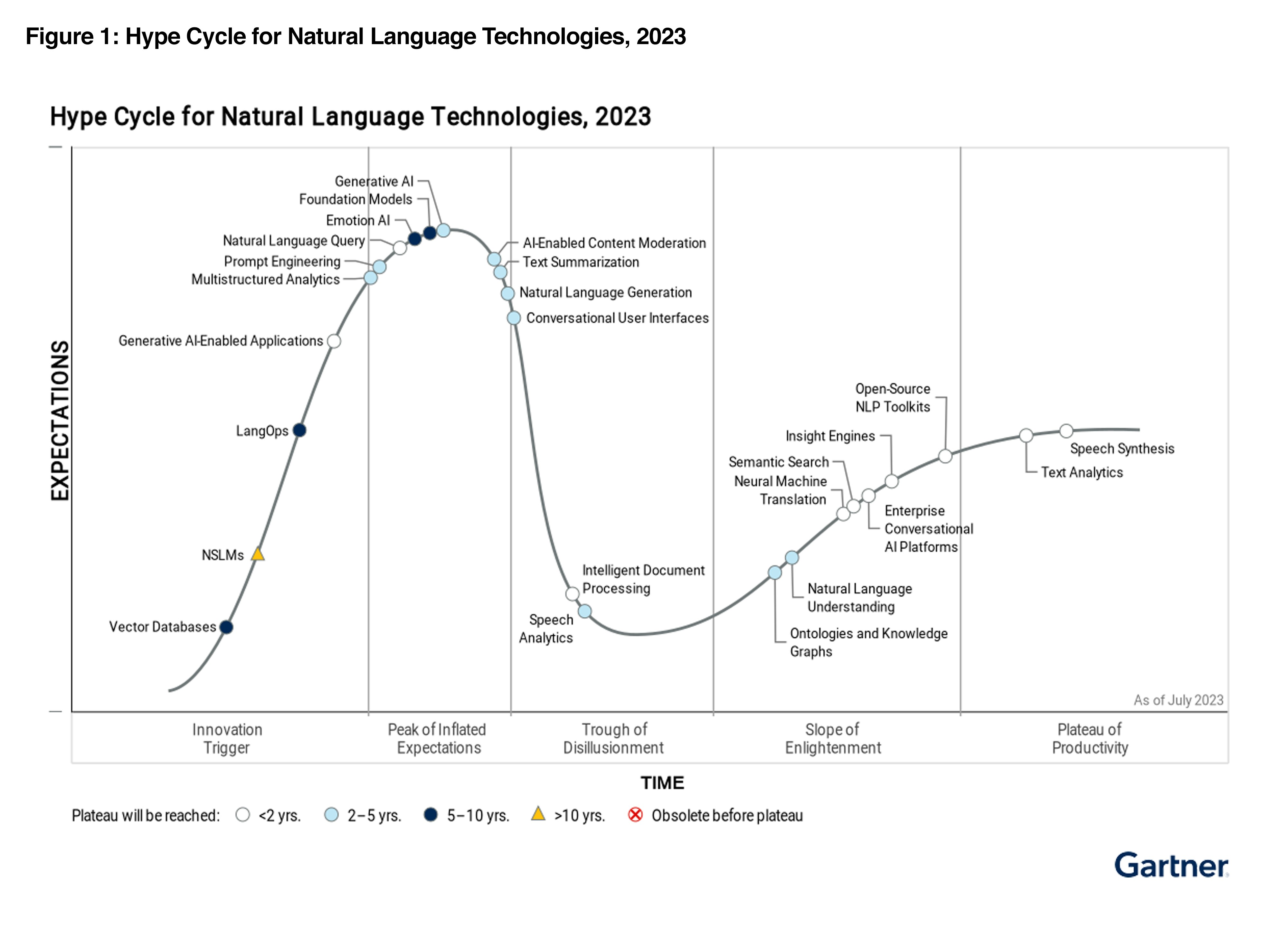
Figure 1. Hype Cycle for Natural Language Technologies, 2023
| Phase | Definition |
| Innovation Trigger | A breakthrough, public demonstration, product launch or other event generates significant media and industry interest. |
| Peak of Inflated Expectations | During this phase of overenthusiasm and unrealistic projections, a flurry of well-publicized activity by technology leaders results in some successes, but more failures, as the innovation is pushed to its limits. The only enterprises making money are conference organizers and content publishers. |
| Trough of Disillusionment | Because the innovation does not live up to its overinflated expectations, it rapidly becomes unfashionable. Media interest wanes, except for a few cautionary tales. |
| Slope of Enlightenment | Focused experimentation and solid hard work by an increasingly diverse range of organizations lead to a true understanding of the innovation’s applicability, risks and benefits. Commercial off-the-shelf methodologies and tools ease the development process. |
| Plateau of Productivity | The real-world benefits of the innovation are demonstrated and accepted. Tools and methodologies are increasingly stable as they enter their second and third generations. Growing numbers of organizations feel comfortable with the reduced level of risk; the rapid growth phase of adoption begins. Approximately 20% of the technology’s target audience has adopted or is adopting the technology as it enters this phase. |
| Years to Mainstream Adoption | The time required for the innovation to reach the Plateau of Productivity. |
Table 2: Hype Cycle Phases
Figure 1 graphically represents the extent to which expectations align with reality across various NLT fields. Table 2 Hype Cycle Phases represents the information on the horizontal axis of Figure 1.
The sections below explore NLT (shown in Figure 1) with greater detail.
Enterprise Conversational AI Platforms
Enterprise Conversational AI Platforms (ECAIP) refer to platforms where chatbots and virtual assistants are enhanced with AI to fulfill diverse roles. They are not just for customer service or service centers; they can also be used for the artificial intelligence-based automation of IT service management and HR tasks, leading to a multitude of applications.
The Hype Cycle report states that “ECAIPs comprise a collection of technologies that enable centralized implementation and operations across multiple chatbot initiatives. They provide enterprise-grade, no-1code tooling to support both Q&A and transactional use cases, and to create custom conversational interfaces to interact with business applications in general. Such platforms include capabilities to improve business outcomes when building, testing, deploying and optimizing AI-enabled conversational interfaces.”
However, according to Gartner, "The number of vendors is still staggeringly large, at more than 2,000 worldwide. However, Gartner estimates that only about 150 of these vendors can be considered to be possible strategic choices for the major use cases.” [1]
For those considering the adoption of ECAIP, careful selection of vendors seems imperative.
Generative AI
Generative AI stands out as a widely-recognized technology that holds potential for significant business impact. Consequently, countless enterprises across various industries are actively experimenting with generative AI to achieve innovation. Gartner predicts, "Most technology products and services will incorporate generative AI capabilities in the next 12 months, introducing conversational ways of creating and communicating with technologies, leading to their democratization. Generative AI will progress rapidly in industry verticals, scientific discovery and technology commercialization. Sadly, it will also become a security and societal threat when used for nefarious purposes. Responsible AI, trust and security will be necessary for safe exploitation of generative AI." [2]
As seen in Figure 1, undue expectations and predictions may introduce unforeseen challenges when implementing generative AI in business. Enterprises keen on introducing generative AI should devise a core strategy for implementing their pilot projects. To better understand the essential factors for making a pilot project successful, click here.
Prompt Engineering
With the advancement of large language models (LLM) like GPT, strategies to utilize these high-performance models more efficiently are under exploration. Among these, crafting the most effective prompts is referred to as prompt engineering.
According to Gartner, "Prompt engineering is the linchpin to business alignment for desired outcomes. Prompt engineering is important because large language models (LLMs) and generative AI models in general are extremely sensitive to nuances and small variations in input. A slight tweak can change an incorrect answer to one that is usable as an output. Each model has its own sensitivity level, and the discipline of prompt engineering is to uncover the sensitivity through iterative testing and evaluation.” [3]
Understanding the nuances between LLM models and grasping their strengths and functionalities appears vital when designing and developing prompt engineering. Especially given the challenges with LLMs, such as producing incorrect information as facts and safety issues reflecting sensitive matters in responses, engineering becomes indispensable. Moreover, prompt engineering can play a pivotal role as a tool that leverages domain knowledge or external tools to extend the capabilities of LLMs.
For fundamental but useful prompt engineering techniques and tips, please refer to the relevant Insights here.
Semantic Search
Semantic Search refers to a search method that calculates the relational association between words by understanding the meaning and context of search terms within naturally expressed text. Rather than merely conducting searches based on simple text, this method analyzes the relationships based on the inherent meaning of the words themselves.
According to Gartner, "Semantic Search amplifies performance by indexing words and their relationships to one another. This enables the processing of what is represented by content and data, as well as the context and intent of natural language queries, thereby improving the accuracy and relevance of experiences compared to keyword-based search. Such an approach impacts all types of search, especially domain-specific, and it can represent a critical component of generative AI pipelines in a variety of design patterns.” [4]
Semantic Search showcases its utility across various domain searches, especially in the acquisition of highly relevant and accurate contexts, which is essential for the implementation of Generative AI. This is particularly relevant for the latest service architecture in LLM utilization, known as RAG (Retrieval Augmented Generation), where it can be used in the search component.
Utilizing NLT in CXP
Langcode's Conversational AI Platform, CXP (Conversational eXperience Platform), actively employs the aforementioned NLT technologies. Most notably, CXP constructs a knowledge base by integrating and connecting various data sources from clients, enabling it to carry out a wide range of tasks requested by users.
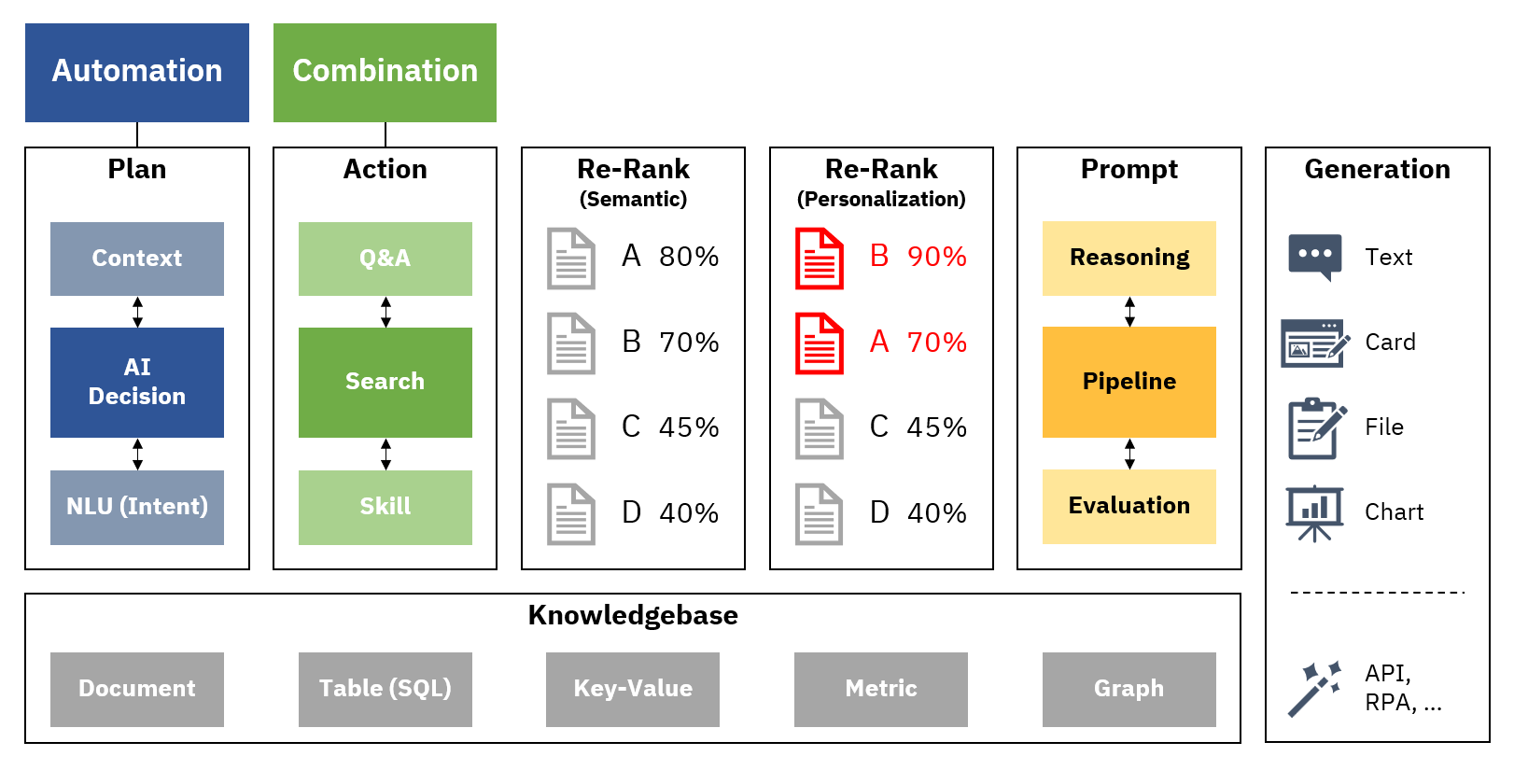
Graphic 1: The Architecture of the Langcode CXP AI Engine
As illustrated in Graphic 1: The Architecture of the Langcode CXP AI Engine, CXP currently utilizes AI technology across several stages. To summarize the overall flow, CXP targets a knowledge base composed of various internal documents and data from clients. Through a custom Semantic Search tailored to the client's domain, CXP then acquires the most relevant knowledge base. Following this, CXP analyzes the acquired knowledge base and selects or generates a prompt that has been engineered to best align with the user's request and context. With the processed knowledge base, user's query, and other contextual information, the Generative AI then provides answers or proposes services that suggest additional necessary actions for the user.
Having specialized in creating conversational AI since its establishment, Langcode has been able to harness many NLT technologies and accumulate technical expertise and know-how. Hence, with its motto "Collaboration through Conversation between Humans and AI," Langcode's CXP is poised to function as a platform ready for integration with ever-evolving technologies.
What's Next?
Given the significant advancements in the NLT field, there are many noteworthy technologies beyond those mentioned in this article. The Gartner report, which contains valuable information analyzing features, significance, impact, and prospects of each technology, can be accessed and reviewed through the provided link.
Furthermore, as the ever-evolving NLT field continues to see ongoing improvements and changes, updates on this topic will periodically be presented through Langcode’s Insight. Stay informed by subscribing to our newsletter.
To read more Gartner recommendations on Hype Cycle for Natural Language Technologies, 2023, click here.
GARTNER is a registered trademark and service mark of Gartner, Inc. and/or its affiliates in the U.S. and internationally, and HYPE CYCLE is a registered trademark of Gartner, Inc. and/or its affiliates and are used herein with permission. All rights reserved. Gartner does not endorse any vendor, product or service depicted in its research publications, and does not advise technology users to select only those vendors with the highest ratings or other designation. Gartner research publications consist of the opinions of Gartner’s research organization and should not be construed as statements of fact. Gartner disclaims all warranties, expressed or implied, with respect to this research, including any warranties of merchantability or fitness for a particular purpose. This graphic was published by Gartner, Inc. as part of a larger research document and should be evaluated in the context of the entire document. The Gartner document is available upon request from Langcode.
[1] Source: Gartner, Hype Cycle for Natural Language Technologies, 2023, Bern Elliot et al., 27 July 2023
[2] Source: Gartner, Hype Cycle for Natural Language Technologies, 2023, Bern Elliot et al., 27 July 2023
[3] Source: Gartner, Hype Cycle for Natural Language Technologies, 2023, Bern Elliot et al., 27 July 2023
[4] Source: Gartner, Hype Cycle for Natural Language Technologies, 2023, Bern Elliot et al., 27 July 2023