



Introduction
This Insight draws on the Gartner® July 2025 research, “Hype Cycle for Generative AI, 2025,” to briefly highlight the current state and impact of the report’s key technologies—and the decision criteria business leaders should keep in mind.
According to Gartner “By 2028, over 95% of enterprises will have used generative AI (GenAI) APIs or models, and/or deployed GenAI-enabled applications in production environments.”
And the report says “The innovations that deserve particular attention within the two- to five-year period to mainstream adoption include AI agent development frameworks, edge GenAI and multimodal generative AI. Early adoption of these innovations can lead to significant competitive advantage and time-to-market benefits. Several innovations remain five to 10 years away from mainstream adoption. Among these, disinformation security and world models present the greatest potential impact.”
In a similar vein, at Langcode we’re seeing a growing share of projects—focused on customer touchpoints (Chat/Assistant, self-service) and internal knowledge-work automation—move beyond pilots into production. In particular, among large Korean enterprises adopting our CXP (Conversational eXperience Platform), the number of projects that have transitioned to or are already in production has more than doubled year over year.
Against this backdrop, we look at how the report analyzes three technology areas that enterprises are currently most interested in: ① RAG standardization and advancement (balancing accuracy, citations, and latency), ② expanding from orchestration to agents (agent frameworks; MCP-based task execution), and ③ AI TRiSM (policies, evaluation, and runtime enforcement).
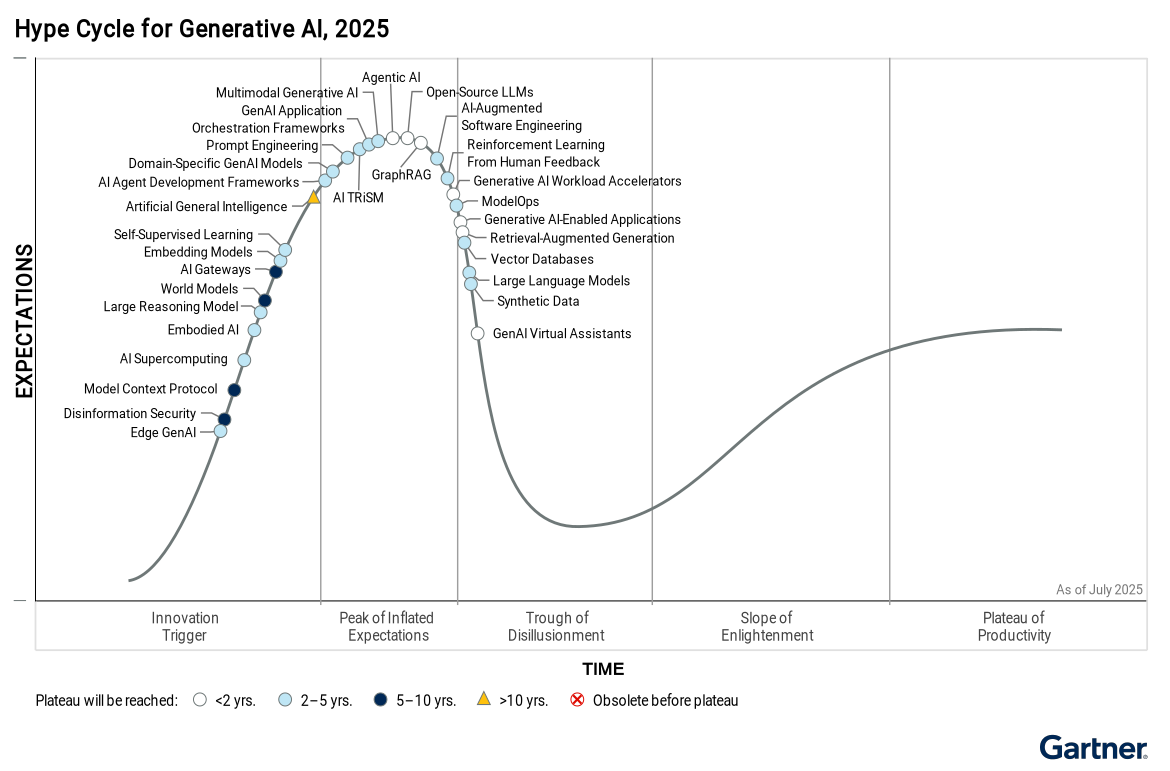
Figure 1: Hype Cycle for Generative AI, 2025
Main Content
From here, we examine the report’s analysis of each technology within the enterprise-focused areas above. Definitions of the analytical terms used in common are provided below.
Grounded Conversational Intelligence
The subject of this paragraph concerns the pipeline responsible for grounded generation that flows through LLM-RAG-Vector DB. LLM serves as the engine for natural language analysis and generation, RAG is an architectural pattern that makes outputs current, accurate, and verifiable by retrieving in-house/domain knowledge and injecting it into prompts, and Vector DB becomes the infrastructure that stores embeddings and rapidly processes semantic similarity searches at scale. By standardizing (chunking, embedding/indexing policies, hybrid search and semantic re-ranking, source attribution) and advancing (GraphRAG, metadata filtering, evaluation loops) these three elements, it becomes possible to systematically optimize the balance between accuracy-source credibility-latency-cost, creating a foundation that can extend beyond FAQs to knowledge work and customer-facing operations.
Large Language Model
Benefit Rating: Transformational
Market Penetration: More than 50% of target audience
Maturity: Mature mainstream
Business Impact
As the most prominent type of foundation model, LLMs are being adopted across all industries and business functions. Organizations are using them to build question answering systems, summarize and classify documents, translate and edit text, generate and explain programming code, and address many other use cases. LLMs have been rapidly incorporated into many enterprise applications, increasing their reach and impact.
Obstacles
■ Unreliability: LLMs produce inaccuracies and hallucinations, making them less suitable for use cases requiring high accuracy.
■ Lack of explainability: LLMs are not currently explainable. The need for decisionmaking transparency will constrain LLM use-case adoption.
■ Multimodality transition: State-of-the-art foundation models are increasingly multimodal. Thus, LLMs, which are trained only on text, may become less predominant in the future.
■ LLM market complexity: Organizations struggle to navigate the wide range of LLMs, validate vendor claims and select the right models for their enterprise use cases.
■ Regulatory environment uncertainty: Intellectual property in LLM training datasets, privacy and confidentiality of enterprise data, and legal liability are some of the issues that will limit adoption.
■ Cybersecurity: LLMs are susceptible to adversarial attacks and prompt injections that could result in data leakage and malicious LLM use.
■ Energy consumption: LLM training and use are very energy-intensive. As LLMs become larger and more widely used, their environmental impact is increasing.
User Recommendations
■ Identify AI use cases, such as content generation, knowledge discovery and conversational user interfaces, where LLMs can deliver a more immediate business impact.
■ Avoid training LLMs from scratch. Prioritize off-the-shelf applications, or augment LLMs with RAG or fine-tuning instead.
■ Follow prompt engineering best practices to optimize LLM performance. Combine LLMs with other applications and tools for more complex design patterns.
■ Validate vendor LLM claims. Consider a wide range of criteria when comparing LLMs, including the type of model required, the model’s benchmark performance, the ability to fine-tune or customize the model, and the broader ecosystem of tools that can support the model.
■ Define a policy for the acceptable use of LLMs and LLM-based applications that clearly identifies the risks of using these tools, as well as the expected user actions to mitigate them.
Retrieval-Augmented Generation
Benefit Rating: High
Market Penetration: More than 50% of target audience
Maturity: Early mainstream
Business Impact
Traditionally, workers spend 20% to 30% of their time looking for information needed to complete business tasks (based on widely reported surveys). RAG can enhance enterprise search and how information is summarized and created, and reduce hallucinations and accelerate productivity. The applications for self-service content consumption for employees and for customer-facing applications have a significant impact on employee and customer satisfaction, brand equity, and workforce productivity.
Obstacles
Underinvestment in enterprise search has been the norm for years. Companies that are still building the discipline and skill sets for robust retrieval and search to support the RAG pattern will experience friction during adoption.
■ Configuration of knowledge base access controls for the RAG pattern is not a trivial task and can prevent widespread adoption across all organizational knowledge.
■ More complex RAG architectures, like agentic retrieval and knowledge-graph-based retrieval (GraphRAG), are increasingly needed to complement hybrid retrieval (keyword and vector search). This challenge is compounded as enterprises deal with multimodal documents, making implementation more difficult.
■ Concerns about IP protection and responsible AI in the use of LLMs are still an obstacle.
■ Vendor fragmentation for building complex RAG implementations, as well as maturing enterprise use cases embedded in business workflows, puts a lot of responsibility for engineering and architecture on enterprise technical teams.
User Recommendations
IT and data and analytics leaders looking at adopting GenAI capabilities on top of private and public corporate data should:
■ Prioritize RAG investments by assessing the maturity and readiness of the enterprise in relation to knowledge management and quality and information retrieval for employees and customers.
■ Pilot applications using the RAG pattern on a well-known knowledge base to assess the lift in the content consumption experience and to gain buy-in for further investment.
■ Plan for investment in filling any skills gaps that exist in internal knowledge engineering capabilities, either through upskilling or external hiring.
■ Engage with technology vendors or service providers that combine both technology and services to accelerate adoption of vertical or domain-specific RAG architecture, including domain data models, vector database, graph database, LLM vendors and agentic platform vendors.
Vector Databases
Benefit Rating: High
Market Penetration: 5% to 20% of target audience
Maturity: Adolescent
Business Impact
Vector databases enable digital business by enhancing semantic search, personalizing recommendations and supporting AI applications with efficient management of unstructured data. They enable deeper insights, scalable data handling and better accuracy of AI, crucial for data-intensive operations. They can be valuable in leveraging data for competitive advantage and in reducing hallucinations, particularly in industries where data volume, complexity and the need for precision in search and analysis are growing exponentially.
Obstacles
Vector databases are superspecialized databases that may cause challenges around data migration, integration and limited extensibility across use cases, although many large database vendors are now starting to offer vector support in existing databases.
■ Most vector databases are delivered as cloud-managed services. The complexity of deploying, configuring and operating them outside cloud environments requires deep technical skills and know-how.
■ Vector databases can be expensive to implement, given the newness of the technology. Moreover, unlike SQL databases, vector databases lack a universal query language, with different vendors offering varying query formats and optimization techniques.
■ For certain use cases dealing with complex information retrieval of various forms of text data or documents that have mixed modalities in the body (text, sections, numbers, tabular data, graphs. etc.), vectorization may not be enough and new approaches like GraphRAG (using graph representations of the entities and relationships in the documents) need to be employed.
User Recommendations
Determine whether your functional requirements can be satisfied by incumbent database vendors that are becoming multimodal and can support the storage and retrieval of vector embeddings — you may not always need a purpose-built vector database.
■ Prioritize developer experience, ecosystem integration, use-case fit, reliability and performance as important selection criteria, and validate them thoroughly via a proof-of-concept process.
■ Select managed, cloud-based vector databases as deployment modes, unless you have stringent requirements and deep technical skills for an on-premises, self-managed deployment mode.
■ Adopt testing practices for RAG architectures that allow you to test multiple vector database options when benchmarking performance for specific applications, as vendor-provided benchmarks may not be appropriate for your use cases.
■ Conduct internal training and education on the appropriate use cases for vector databases, how to leverage their true potential and effective ways to optimize their deployment and maximize their value.
From Orchestration to Agents
This encompasses the topics of connection, orchestration, and automation layers necessary for transitioning from simple conversations to actual business execution. GenAI application orchestration frameworks provide prompt/model chaining, state management, and evaluation/deployment to create operational-level workflows, while AI agent development frameworks implement agents that perform substantive tasks. Here, MCP (Model Context Protocol) standardizes bidirectional context sharing and tool exposure between models and external apps/data, reducing integration costs. When these technologies are applied together, they enable further advancement into agent-type applications that combine multi-LLM and multi-tool configurations through a consistent interface.
MCP (Model Context Protocol)
Benefit Rating: High
Market Penetration: Less than 1% of target audience
Maturity: Emerging
Business Impact
MCP can lead to more context-aware AI systems and can reduce integration effort by
standardizing how to give AI models access to contextually relevant and up-to-date
multimodal data and multistructured analytics beyond their initial training data. However, MCP brings additional security concerns, as well as strategic questions about its usage. It also may be eclipsed by future standards that have greater openness and security.
Obstacles
■ MCP adds new security risks, particularly related to authorization, to data and tools and raises concerns about data privacy and security. Ensuring that classified information is protected and that access is appropriately controlled is crucial.
■ Many organizations already register tools and resources as part of their AI platform architectures. AI development tools such as AIXplain, Boomi AI Studio, Crew.AI, Langchain and SnapLogic already provide mechanisms to register resources to be accessible by LLM-based AI applications and agents.
■ Implementing MCP servers can be complex, especially for legacy systems or diverse technology stacks and may lead to suboptimal architectures and governance. Integrating MCP into existing infrastructure may require significant effort and expertise.
■ MCP is relatively new and is evolving rapidly, with limited backward compatibility. Early adopters may face challenges with keeping implementations up to date with the latest version of the standard.
User Recommendations
■ Investigate MCP clients to understand the benefits and risks, and compare these with the capabilities offered by your AI development platforms.
■ Prototype MCP servers for your internal systems and data sources to facilitate streamlined access for AI applications developers.
■ Avoid the highest risks associated with the current MCP standard by prohibiting remote MCP server implementations that are externally accessible. Any use of external MCP servers should be strictly controlled within a test environment to assess MCP benefits, rather than deploying them in production.
■ Budget to address technical debt, ensuring your teams have the resources and time to monitor the standard’s evolution and adapt their implementations accordingly, with the flexibility to abandon the standard if MCP loses its initial advantage.
■ Strengthen security measures by requiring MCP servers to use HTTPS endpoints and implementing OAuth, while fortifying configurations to protect MCP client and server description files.
AI Agent Development Frameworks
Benefit Rating: Transformational
Market Penetration: 5% to 20% of target audience
Maturity: Emerging
Business Impact
AI agent development frameworks enable existing static applications to transform into
intelligent applications capable of contextual reasoning and dynamic task execution. With
growing demand for agents capable of autonomous planning, multitool interaction (such
as model context protocol) and learning, these frameworks play a foundational role in
operationalizing AI applications and agents to support business and customer needs.
Drivers
■ Significant interest in LLM-based AI agents fuels the need for low-entry barriers in building AI agents, resulting in the growth of AI agent development frameworks.
■ Advances in the capabilities of AI large language models and large reasoning models are enhancing the perception, reasoning and planning abilities of AI agents to support increasingly complex business use cases.
■ Real-world use cases are emerging: document processing, research agents, content generation, interaction with GUI like computer-using agent mode, and even code writing assistants using AI agents.
■ The frameworks abstract model handling, allowing developers compose, deploy and iterate on agents using cloud-based LLMs, local models or hybrid backends.
■ Open-source communities are significantly contributing to the development of AI agent frameworks, resulting in more feature-rich solutions.
Obstacles
■ Most frameworks remain below version 1.0 and are evolving rapidly, which may introduce breaking changes.
■ While powerful, many tools lack built-in guardrails, requiring developers to manually
implement evaluation, fallback and safety mechanisms.
■ Most frameworks are Python-centric, making integration with enterprise applications
in other languages more complex.
■ The nondeterministic nature of AI agents does not allow them to fully replace the
“standard” applications and core systems due to the risks of an error. This therefore
slows adoption of AI agents.
■ Multi-agent workflows are harder to manage at scale and require thoughtful orchestration and observability design. They also increase inference costs, requiring judicious selection of foundation models and iteration settings.
User Recommendations
■ Start with well-scoped, low-risk use cases such as document summarization or back-office customer support.
■ Identify the use cases where you require the highest level of customization for AI agents beyond what typical AI agent no-code builders or robotic process automation tools can offer.
■ Select the frameworks based on the several criteria such as multiagent support, access to ecosystem and tools coverage, memory support, ease of use, and code execution.
■ Use cloud-native compute models (e.g., function as a service, containers) for scalable deployments. Integrate observability tools (e.g., LangSmith, MLflow) for debugging and tracing. Constantly evaluate AI agents with eval tools and frameworks (e.g., Arize AX, Confident AI DeepEval) while setting guardrails around the AI agents.
■ Invest in compatible architecture and an API-first approach, RAG pipelines and data governance to support flexible agent behavior.
■ Be aware that building complex, distributed AI-agentic systems requires significant investment in API-driven orchestration, as nondeterministic workflows can impact performance.
■ Follow open-source communities closely for rapid improvements and emerging best practices.
■ Tackle the coordination, complexity and communication challenges in AI agent design (see Emerging Patterns for Building LLM-Based AI Agents).
GenAI Application Orchestration Frameworks
Benefit Rating: High
Market Penetration: 5% to 20% of target audience
Maturity: Adolescent
Business Impact
GenAI application orchestration frameworks enable production-ready, composable and extensible AI applications and agents. These frameworks allow teams to build, iterate and deploy GenAI apps quickly, reducing time from idea to production, enabling faster time to value. They also enable businesses to lower vendor lock-in and reduce cost, through usage of multiple models, often smaller, cheaper models, for low-complexity tasks and reserve larger models for high-value tasks.
Obstacles
■ Immaturity: Although the tools are gaining developer mind share, there are still gaps in meeting enterprise needs for stability and robust integration. Therefore, enterprise AI teams must cautiously navigate software bugs and security issues, characteristic of most early-stage projects.
■ Lack of clear winners: Although these orchestration frameworks are designed to bridge GenAI application development, their longevity and ability to innovate iteratively remain unknown.
■ Integration challenges: Most enterprises operate with a mix of legacy systems and modern applications, making integration with GenAI orchestration frameworks difficult.
■ Lack of awareness: These tools are new and there is a lack of understanding of what they do, which one to use and how to safely deploy them.
■ Customization and flexibility: Although these tools offer general capabilities for integrating GenAI models into application workflows, specific enterprise needs might require more customization than is currently available.
User Recommendations
■ Encourage experimentation on what these tools do and their potential fit with your technical architecture to reduce vendor lock-in and enable better integration.
■ Identify the use cases in which you are implementing prompt engineering, data retrieval or fine-tuning, which can benefit from these tools.
■ Select tools that offer APIs and customization options that align with your current and future needs.
■ Explore the autonomous agent capabilities of these tools cautiously, given the black-box nature of machine-to-machine interaction. Seek an adequate balance between capabilities, integration, governance and cost-efficiency.
■ Take a centralized platform approach to achieve standardization and automation across the GenAI applications you are building.
AI TRiSM
AI TRiSM (AI Trust, Risk and Security Management) refers to a four-layer technical framework that ensures governance, fairness, security, privacy, and other factors when enterprises utilize AI. New risks that AI can cause, such as data breaches and inaccurate outputs, are difficult to address with existing control methods, so enterprises must control AI behavior to align with their intentions. In the rapidly changing AI market, AI TRiSM is essential for enterprises to respond flexibly without becoming dependent on specific models or vendors.
Benefit Rating: High
Market Penetration: 5% to 20% of target audience
Maturity: Early mainstream
Business Impact
Organizations that do not consistently manage AI risks are exponentially inclined to experience adverse outcomes such as project failures, AI mis-performance and compromised data confidentiality. Inaccurate, unethical or unintended AI outcomes, process errors, uncontrolled biases, and interference from benign or malicious actors can result in security failures, financial and reputational loss, or liability and social harm. AI mis-performance can also lead organizations to make suboptimal or incorrect business decisions.
Obstacles
■ Adopting AI TRiSM technology is often an afterthought. Organizations generally don’t consider it until AI applications are in production, when it becomes challenging to retrofit.
■ Many enterprises are resource-constrained and don’t have the skills or capacity to implement TRiSM technology.
■ Enterprises often rely on their incumbent vendors to provide AI functionality for TRiSM capabilities though they often lack it, and must rely on vendor licensing agreements to ensure their confidential data remains private in the host environment.
■ Off-the-shelf software that embeds AI is often closed and does not support APIs to third-party AI TRiSM products that can enforce enterprise policies.
■ Most AI threats and risks are not fully understood and not effectively addressed.
■ AI TRiSM requires a cross-functional team, including legal, compliance, security, IT and data analytics staff, to establish common goals and use common frameworks.
■ While AI TRiSM can integrate life cycle controls, this poses significant implementation challenges especially with embedded AI that often lacks API support.
User Recommendations
■ Set up an organizational unit to manage AI TRiSM that is integrated with the organization’s overarching governance initiative. Include members with a vested interest in AI projects.
■ Define acceptable use policies at a level granular enough to enforce.
■ Discover and inventory all AI used in the organization, leveraging the capabilities of AI TRiSM vendors who support this.
■ Revisit and implement data classification, protection and access management across all enterprise information — both structured and unstructured — that can potentially be utilized by AI. Collaborate across different teams involved in information governance.
■ Work with legal and compliance to contractually define accountability and responsibility for unacceptable AI use or behavior in third-party-embedded AI applications.
■ Obtain vendor attestation to meet legal requirements.
■ Evaluate and implement layered AI TRiSM technology to continuously support and enforce policies across all AI entities in use. This includes enterprise-owned AI TRiSM services, along with controls offered by frontier model providers, but do not solely rely on the latter.
Conclusion
Using the observation framework from Gartner’s “Hype Cycle for Generative AI, 2025,” this Insight compares each technology on consistent criteria (utility rating, market penetration, and maturity). The Hype Cycle series is less about picking winners and more like a map that helps estimate distance to mainstream adoption and the breadth of potential impact. Accordingly, rather than leaning into optimism or pessimism about any one technology, it’s best interpreted as guidance for metric-based expectation setting and phased adoption.
Practically speaking, based on your organization’s business objectives and risk tolerance: (1) within 2025, shortlist the items with the most direct utility to your industry or function; (2) agree on evaluation criteria in advance; and (3) proceed in the order of small pilot → incremental expansion, anchored by an AI TRiSM baseline (policy, audit, and runtime enforcement). Items on a 5–10 year horizon should remain in the explore/observe bucket, while also checking readiness across talent, data, and governance to reduce risk.
Ultimately, what matters is comparing with consistent criteria and deciding with verifiable metrics. Use the Hype Cycle frame as a compass: start with technologies aligned to your goals and reality, learn fast, and scale broadly.
If you’d like to read the original Gartner research, please refer to the separate download link provided.
Attributions and Disclaimers:
This graphic was published by Gartner, Inc. as part of a larger research document and should be evaluated in the context of the entire document. The Gartner document is available upon request from Langcode.
GARTNER is a registered trademark and service mark of Gartner, Inc. and/or its affiliates in the U.S. and internationally, Hype Cycle is a registered trademark of Gartner, Inc. and/or its affiliates and is used here in with permission. All rights reserved.
Gartner does not endorse any vendor, product or service depicted in its research publications, and does not advise technology users to select only those vendors with the highest ratings or other designation. Gartner research publications consist of the opinions of Gartner’s research organization and should not be construed as statements of fact. Gartner disclaims all warranties, expressed or implied, with respect to this research, including any warranties of merchantability or fitness for a particular purpose.