


In the world of artificial intelligence, generative AI holds remarkable promise, serving as a potent tool for businesses across a multitude of industries. According to McKinsey&Company, “generative AI has the potential to change the anatomy of work, augmenting the capabilities of individual workers by automating the capabilities of individual workers by automating some of their individual activities. Current generative AI and other technologies have the potential to automate work activities that absorb 60 to 70 percent of employees’ time today.” [1]
In today’s fast-paced technological landscape, running a successful pilot project with generative AI has become an essential movement for organizations seeking innovation and competitive advantage. However, the path to successful implementation is often fraught with complex challenges. If you've ever pondered over the most effective strategies to execute a generative AI pilot project or questioned why many organizations fail in their AI endeavors, you're in the right place.
Obstacles in Generative AI Project Success
According to McKinsey&Company, “excitement over generative AI is palpable, and early pilots are compelling. But a full realization of the technology’s benefits will take time, and leaders in business and society still have considerable challenges to address. These include managing the risks inherent in generative AI, determining what new skills and capabilities the workforce will need, and rethinking core business processes such as retraining and developing new skills.”
Also, according to the 2023 Gartner® How to Pilot Generative AI report, “organizations are planning to implement generative AI. In a recent Gartner webinar, 45% organizations have seen an increase in AI investment since ChatGPT was released, and 68% of executives believe that generative AI benefits outweigh its risks. However, despite this excitement, organizations struggle to get started: Only 19% of organizations are currently running a pilot or producing generative AI.” [2]
To truly capitalize on the transformative powers of generative AI, organizations must align their implementation with their overarching strategic vision. This involves not only a clear understanding of business imperatives but also a comprehensive evaluation of the potential rewards and risks associated with the adoption of generative AI. Furthermore, to foster collaboration and ensure seamless execution, it's imperative to establish a dedicated, empowered cross-functional team. This team should focus on eliminating operational silos and promoting cohesive and informed actions that push the boundaries of what generative AI can achieve.
Here are some of the most common pitfalls of running a generative AI project:
Navigating Your Successful Generative AI Projects
Then what steps can IT leaders take to initiate and run a generative AI pilot? According to Gartner, “IT leaders need a systematic way to navigate the wide space of opportunities. They must find and prioritize a few of the most promising use cases for their organization and run a pilot to quickly deliver and validate these ideas in practice. To achieve this, IT leaders can follow the five steps described in this research (see Figure 1).”
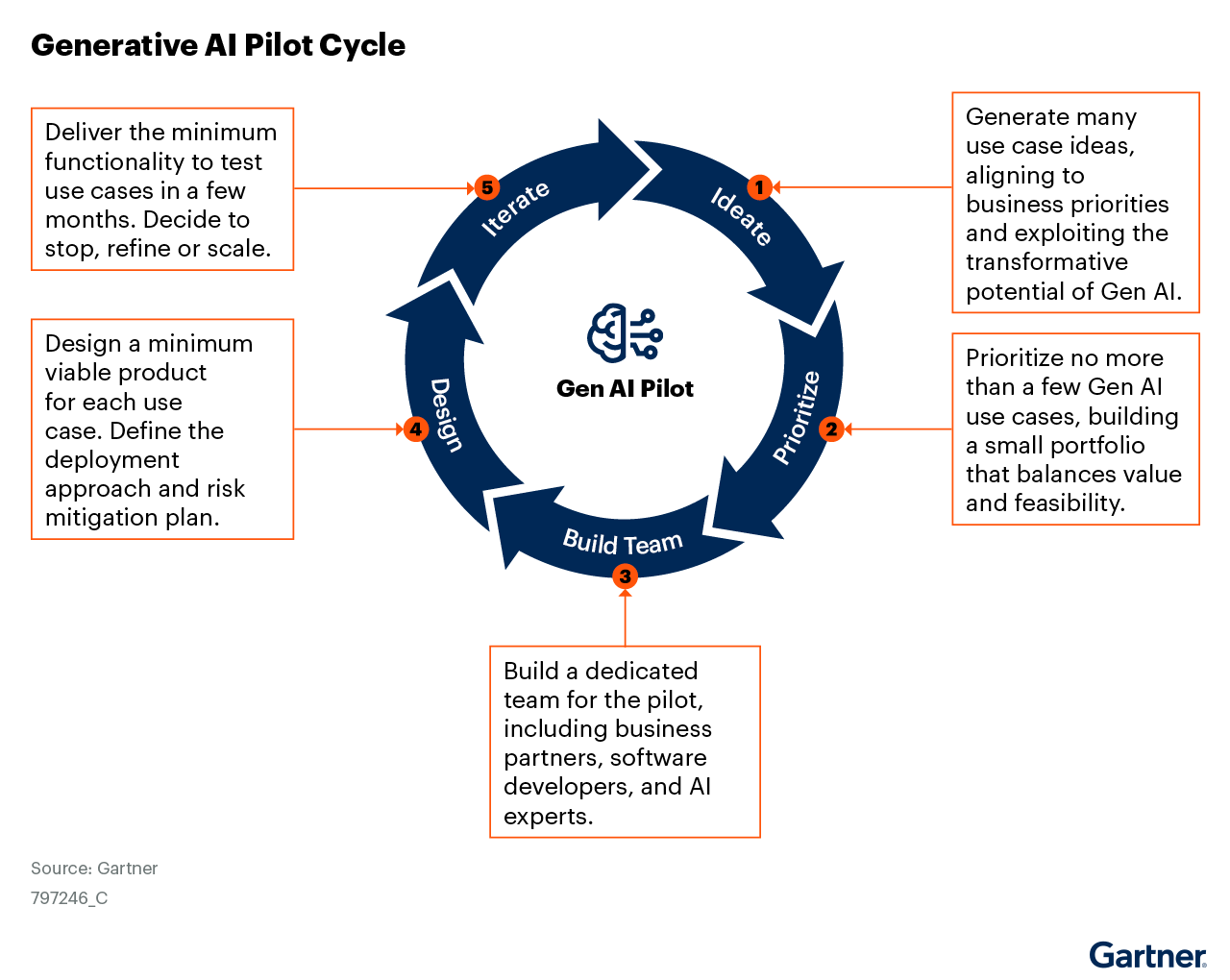
Figure 1: Generative AI Pilot Cycle
In this way, understanding how to run a successful pilot project with generative AI is essential for organizations aiming to lead in their respective sectors. In other words, it’s not just about leveraging the tech but about deploying it in a manner that aligns with business goals. According to Gartner, as an IT leader focused on leveraging generative AI to create business value, you should:
To sum up, the journey of implementing a generative AI pilot is one of discovery, learning, and adaptation. By following these best practices and guidelines, organizations can navigate the complexities of this emerging field and set the stage for larger, more ambitious AI projects in the future.
The Challenge of Generative AI Implementation: Why Choosing the Right Vendor is Key
However, as with any groundbreaking technology, the implementation of Generative AI isn't a walk in the park. The challenges are numerous and multifaceted, but one strategy that stands out as a game-changer is the selection of the right vendor.
Understanding the Challenges
1
2
3
4
The Role of the Right Vendor
Navigating the intricacies of AI implementation presents numerous challenges, from the complexities of integration and the demand for high-quality data to addressing the current talent scarcity and ethical implications. Furthermore, AI models demand ongoing refinement and adjustment. Given these factors, the importance of aligning with a dependable vendor is evident. As per the Gartner insights, consider at least the five criteria when selecting a vendor for your pilot.
| Criteria | Description |
| Performance | Not all foundation models are created equal. It is important to assess and compare the performance of the underlying foundation models, ensuring the vendors have the type of model required for your use case (chat model, embedding model, etc.). This should include a consideration on the latency required for your use case. |
| Customizability | Depending on the selected design pattern, it is key to check if it is possible to customize the application and/or underlying foundation model. For instance: Is it possible to create customized workflows? Is it possible to inject your data via retrieval? Could the vendor solution integrate with your own systems? |
| Privacy, Security and Data Retention | It is critical to establish legally binding data protection/privacy assurances in license agreements with vendors hosting the LLM models. Some vendors store the prompt data until a certain time for debugging purposes in the event of a failure or for investigating patterns of potential abuse and misuse. You must check if this data retention meets your own enterprise security policies. |
| Pricing | It is important to consider the different pricing models (e.g., subscription, API pay-as-you-go pricing) as well as additional costs (cloud and AI infrastructure, implementation costs, etc.). The costs will vary depending on the use case, scale and requirements of the pilot. |
| Other Long-Term Considerations | There will be other considerations that are less important for the pilot, but much more important for a longer-term engagement, such as the maintenance and support offered. |
Table 4: Vendor Criteria for Generative AI Pilot [4]
Understanding these challenges and the industry's recommended criteria underscores the need for a solution that's robust, adaptable, and trustworthy. Many solutions may claim effectiveness, but only a few truly align with expert guidelines and deliver on their promises. With this in mind, allow me to present why we believe the Langcode CXP solution stands out as the premier choice to meet these challenges effectively.
1
2
3
4
Transform your pilot initiative with Langcode Conversational eXperience Platform(CXP) harnessing Generative AI
Navigating generative AI's intricacies can be simplified with a knowledgeable partner by your side. Vendors, with their expertise and experience, can guide organizations through the maze, ensuring fewer missteps and more concrete results. As a trusted vendor, we not only provide a solution but also walk alongside customers, ensuring that the journey from conceptualization to implementation is smooth and impactful.
Imagine an enterprise where interactions are seamless, processes are automated, and innovations are routine. That’s the promise our conversational AI solution brings. Harnessing the power of generative AI, we offer enterprises a tool that transcends conventional boundaries, driving productivity and growth. We are actively collaborating with industry leaders, such as down below, piloting our solutions in real-world scenarios. These collaborations provide us with unique insights, ensuring our solutions are always one step ahead, aligning with evolving enterprise needs.
[Finance]
[Public]
Tap into the potential of generative AI now – not in the future.
Instead of taking long journey of building a solution from scratch, your organization can leverage Langcode’s ready-to-use enterprise conversational AI, driven by advanced generative AI technology. Langcode’s Conversational eXperience Platform(CXP) enables you to easily utilize tailored responses for various requests through Q&A, task automation, and data visualization, powered by the combined application of various AI technologies and multimodal generation capabilities. The end result is an enterprise implementation that harvests the benefits of generative AI, eliminating the cost and complexity of in-house solution.
With Langcode CXP, enterprises can stay focused on higher-level goals like driving new businesses outcome and enhancing work productivity while fast-tracking success through the latest innovations in generative AI without having to wait. To learn how CXP helps leading companies achieve AI democratization through conversation, please click here. You’ll be on your way to transforming how your organization leverages knowledge through a market-leading enterprise conversational AI platform – without any of the hassles of building it yourself. Langcode can guide you through the entire process, ensuring you gain a comprehensive understanding of the key elements that contribute to a robust and effective pilot project. Let's explore the possibilities and unlock the potential of generative AI together.
To read more Gartner recommendations on How to Pilot Generative AI, click here for complimentary access to this report.
GARTNER is a registered trademark and service mark of Gartner, Inc. and/or its affiliates in the U.S. and internationally and is used herein with permission. All rights reserved. Gartner does not endorse any vendor, product or service depicted in its research publications, and does not advise technology users to select only those vendors with the highest ratings or other designation. Gartner research publications consist of the opinions of Gartner’s research organization and should not be construed as statements of fact. Gartner disclaims all warranties, expressed or implied, with respect to this research, including any warranties of merchantability or fitness for a particular purpose.
[1] Source: McKinsey&Company, The economic potential of generative AI, The next productivity frontier, June 2023